
She had been running her consulting business for four years when we first spoke. Strong client list. A team of six. Revenue that had doubled in eighteen months. But she opened the conversation by saying her brand made her look like a freelancer, not a firm.
She was not wrong. The logo was made on Canva in 2021. The website copy still said “I” instead of “we”. The colour palette was chosen because she liked it, not because it communicated anything. And every time she pitched a mid-size company, she felt the brand working against her before she even opened her mouth.
That is the gap this guide is about. Not startups trying to figure out who they are. Businesses that have already figured it out but whose brand never got the memo.
This rebranding strategy guide is for them.
What Rebranding Strategy Guide Actually Means
We are going to be blunt here because the confusion around this word has cost a lot of Indian founders a lot of money.
Rebranding is not a new logo. It is not a prettier website or a colour palette that feels more current. A new logo on top of confused positioning is just expensive decoration. A rebranding process is a deliberate shift in how your business is understood by the people you actually want to reach. That means positioning, messaging, and visual identity moving together because a real strategic reason exists for the change.
Change only the visuals and nothing underneath changes. Change only the messaging and the first impression still does not match. You need all three or the investment does not translate into anything your customers actually feel.
At Resource Geeks Networks we have seen this enough times to say it plainly: most founders go to design first because you can react to a logo. You cannot react to a positioning statement the same way. So strategy gets skipped. And then the new logo sits on top of the same confused foundation and nobody can explain why nothing feels different.
When Should You Rebrand Your Business?
When the gap between what your brand says and what your business actually is has become something you manage daily.
Here is what that looks like in real life. Your product has evolved significantly but your brand still introduces you as the version of the business from three years ago. You are now pitching better clients and the brand is forming the wrong impression before you get through the first two minutes. You are expanding into a new city, a new category, or a new type of customer. A merger happened. A pivot happened. Something changed at a structural level and the brand never followed.
None of those are small problems. They are each a version of the same thing: your brand is doing active damage every time a potential client encounters it before they meet you.
What is not a reason to rebrand: you are tired of how it looks. Your competitor just launched something slick. It has been a few years. Rebranding from boredom or competitive anxiety is how you spend ₹3,00,000 and confuse the customers who were already loyal.
A Bynder survey of over 1,000 marketers found that 57% cited updating brand identity as the primary reason for rebranding, followed by market repositioning at 45% and a shift in target audience at 41%. Almost always a proactive growth decision. Almost never a crisis response.
Signs You Actually Need It
Your brand is introducing the old version of you. The business has matured. The pricing has moved. The clients have changed. The brand is still making the first impression of year one. People feel that mismatch even when they have no language for what is bothering them.
You are invisible beside your competitors. Not dramatically. Just quietly. Someone puts four options in front of a client and yours does not read as distinct enough to hold its position in the conversation. That is a positioning problem and the visual identity is just the part making it visible.
You soften expectations before sharing your website. You say it is outdated. You say it is being worked on. You follow the link with a disclaimer. We have had this exact conversation with founders whose businesses were genuinely excellent. We wrote about why this costs more than people realise in our piece on brand identity design elements that build trust and drive sales.
Your traffic is fine but enquiries have not grown with it. Usually not a traffic problem. Usually a credibility problem. People arrive and something in the brand does not hold up to the scrutiny of someone who is seriously considering spending money.
The Rebranding Process, Step by Step
Do the audit before you brief anyone.
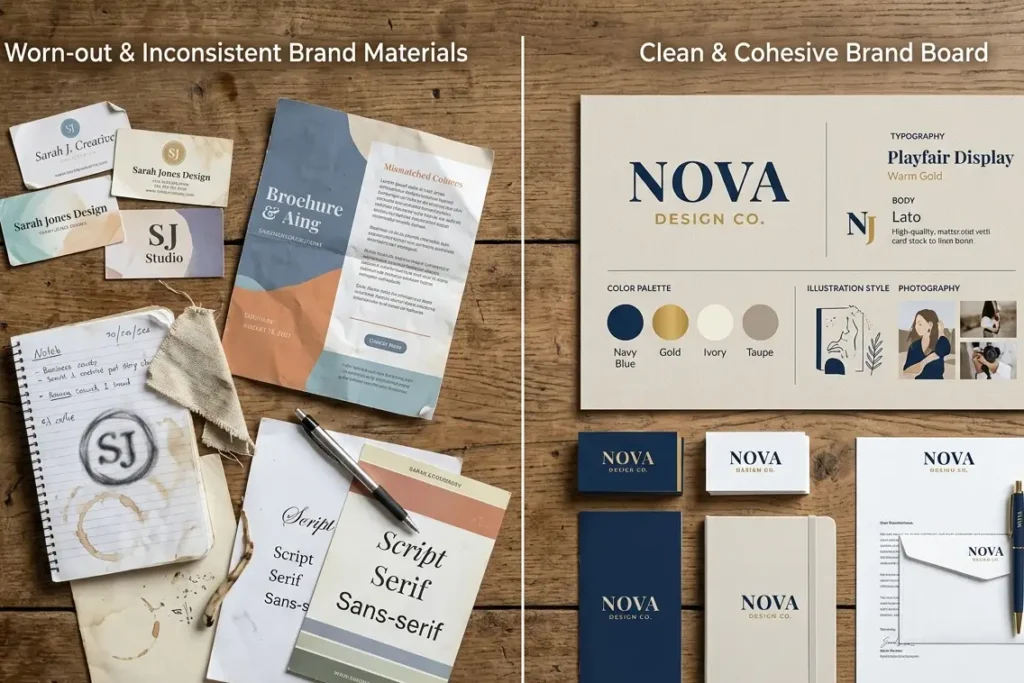
Go through everything the brand currently touches. Website, proposals, pitch decks, email signatures, social profiles, packaging if there is any. Ask yourself honestly whether they feel like they came from the same company in the same decade. Then ask three or four actual customers, not your team, how they would describe you to someone who had never heard of you. The gap between what they say and what you want them to say is your real brief.
Strategy before design. Every time.
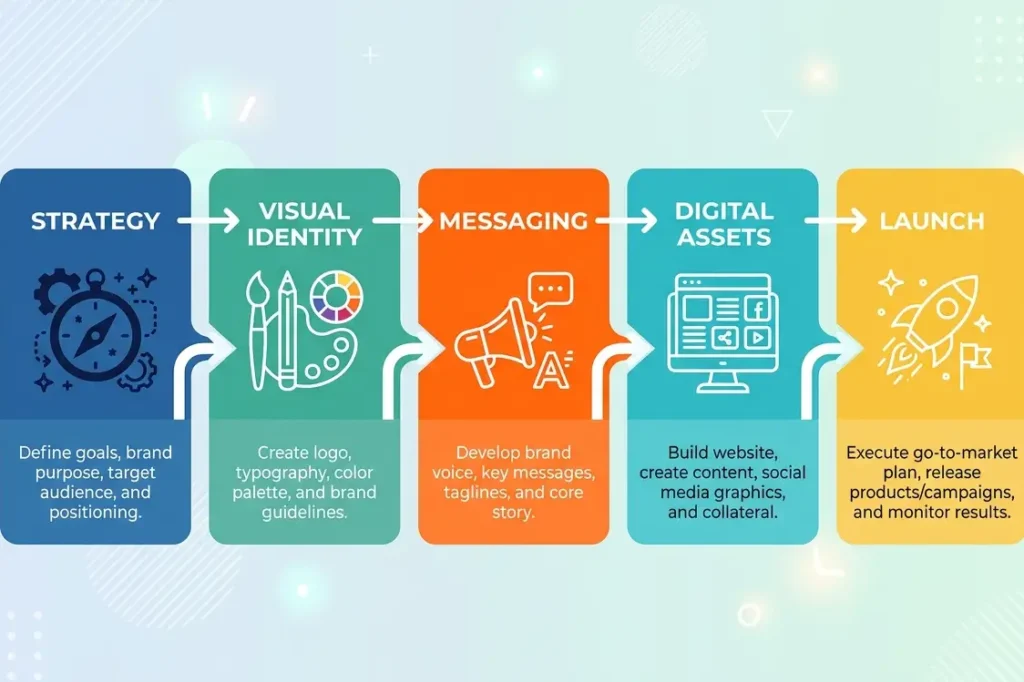
Your brand refresh strategy needs a positioning statement that actually differentiates you, an updated audience picture that reflects who you are actually serving now, a brand voice that matches how you want to be perceived, and a core message that a prospective client could repeat back. Research shows companies that put 70% of their rebranding budget into strategy and 30% into creative execution outperform those who reverse that ratio by three to one. Strategy conversations are uncomfortable. They surface disagreements inside the founding team. They take longer than picking colours. Do them anyway.
Redesign for coherence, not novelty.
Visual identity follows confirmed strategy, not the other way around. Logo, colour system, typography, photography direction, website design language. For Indian audiences, if the design does not work perfectly on a phone, it does not work. That is not a preference. That is where most of your visitors are.
Rewrite the language alongside the visuals.
Brand voice, website copy, tagline, social tone. Skipping this step is the single most common reason rebrands fail to land. The result is a striking new visual identity placed directly on top of the same confused language from two years ago. Both have to change or neither change is complete.
Update in the right sequence.
Website first. Then social profiles, email signatures, proposals, printed materials. Your website is the first place anyone goes to verify you. It should be the first to reflect who you actually are now.
Launch as an explanation, not a reveal.
Tell your existing customers what changed and why before the public announcement. Bynder’s data puts the average rebrand at seven months from first conversation to full rollout, with around 215 assets needing to be updated across a typical business. The launch is the start of a longer conversation about where you are headed, not a moment that closes anything.
What Most Guides Miss About India
Almost all rebranding strategy content is written for markets that are not this one. A few things that matter specifically in India and are consistently left out.
India is not one audience. A brand that reads as premium and credible in Bangalore can feel impersonal and inaccessible in Coimbatore, Surat, or Bhopal. Before anything else, we ask every brand that comes to us whether they are building a pan-India identity or a market-specific one. That single answer changes every positioning and visual decision that follows.
Your website is doing more work than most founders give it credit for. In India’s digital-first buying culture, most decisions form before anyone picks up the phone. The website is where trust is built or quietly lost. If the brand does not hold up at that moment, the conversation is over before it starts.
Regional language is one of the most underused trust signals available. For brands genuinely targeting tier-2 and tier-3 markets, a single regional language touchpoint in key communications creates a sense of recognition that no English-only brand can replicate. It tells people you are not just broadcasting from a template made for someone else.

Mistakes That Quietly Sink a Rebrand
Using rebranding to hide a problem instead of solving one. A new identity does not fix weak delivery, confused internal culture, or a product that has not kept up. Audiences today see through cosmetic changes almost immediately, and design updates without genuine operational improvements tend to backfire rather than rebuild trust. The underlying problem has to be worked on alongside the rebrand. Covering it with new visuals just makes the gap more obvious once the novelty wears off.
Leaving SEO out of the plan until after the site goes live. A website redesign that changes URL structures without a redirect strategy can destroy years of organic search equity in weeks. It is one of the most painful and avoidable mistakes in the rebranding process. It needs to be inside the plan from day one.
Not bringing your existing customers with you. Loss aversion research consistently shows people experience losing a familiar brand as roughly 2.5 times more painful than gaining equivalent new benefits. Frame the change as an evolution of what they already trust. Let them find out from you, with context, not from a Google result that looks different to what they remembered.
Committing to production runs before you have tested anything. This is most common in product businesses. New branded packaging ordered at full MOQ before a single real customer has reacted to the new direction. Test small. Learn first. Then commit.

Rebranding vs Brand Refresh Strategy
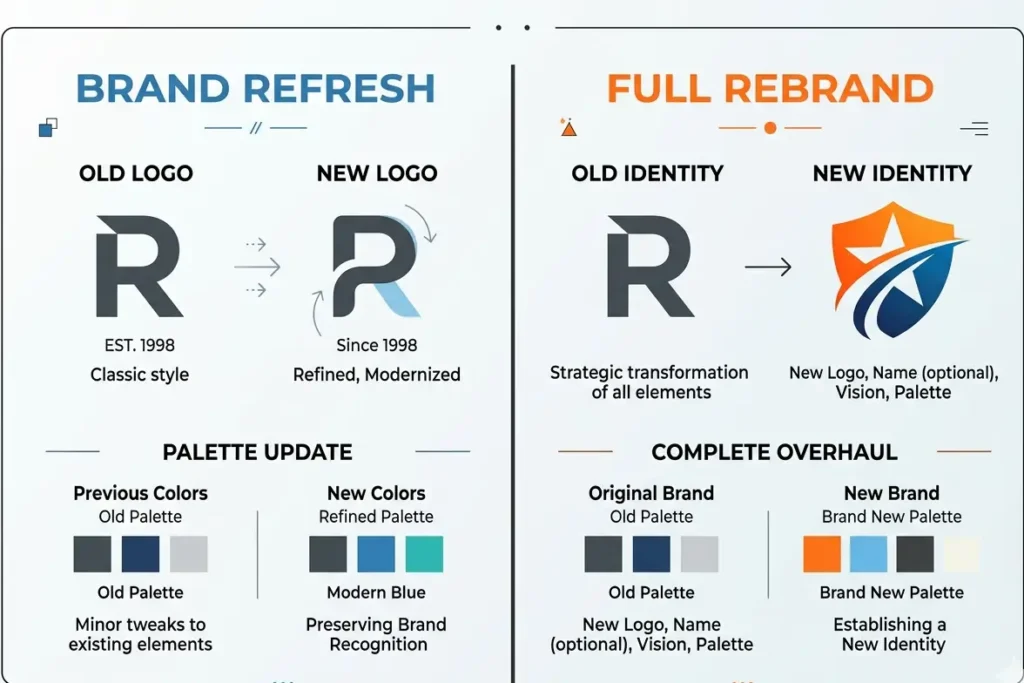
A brand refresh strategy updates specific elements without shifting the fundamental positioning or the audience you are talking to. The brand remains recognisable. It just looks and sounds like the current version of itself rather than a version from several years ago.
A full rebrand is more foundational. Positioning, audience definition, sometimes name and category. It is a business decision that requires design to execute, not a design decision that grew into something bigger.
The simplest test: ask five people outside the business what they think you do. Consistent and accurate answers and a refresh is likely enough. Scattered or wrong answers and you are already in rebranding territory whether or not you planned to be.
When should you rebrand your business rather than refresh it? Refresh when the brand is trusted but dated. Rebrand when it is creating active confusion about what you do, who you do it for, and why someone should choose you over the next result on the page.
FAQs
What is a rebranding strategy?
A structured plan for changing how your business is perceived, covering positioning, messaging, and visual identity together. It is a business decision with a clear reason behind it, not a design project that got bigger than intended.
When should you rebrand your business?
When your brand is actively creating confusion or costing you business. Common triggers are a significant product or service shift, entering new markets, a change in the audience you are actually serving now, or a growing gap between how you are perceived and how you need to be seen to win the clients you want.
How long does the rebranding process take?
A focused brand refresh might take six to eight weeks. A full rebrand covering strategy, identity, website, and digital assets typically runs four to seven months. Bynder’s survey of over 1,000 marketers found the average rebrand takes seven months in total from first conversation to full rollout.
Does rebranding affect Google rankings?
Yes, significantly if it is not planned carefully. A website redesign that changes URL structures without proper redirects can collapse organic traffic almost overnight. SEO migration has to be inside the plan from the start.
What does rebranding cost in India?
A focused brand refresh typically runs between ₹80,000 and ₹3,00,000 depending on scope. A full strategic rebrand covering strategy, identity, website, and communications sits between ₹3,00,000 and ₹10,00,000 or more for mid-stage businesses. The cost of not rebranding when it is genuinely needed is usually higher than the cost of doing it well.
Ready to Rebrand Without Losing What You Have Built?
Most rebrands go wrong because they start with design instead of strategy. If your business has genuinely outgrown its brand but you are worried about losing the trust you have already built with your clients, that is the specific problem we work on at Resource Geeks Networks.
We have done this across D2C, services, and product categories with businesses across India. We know what a rebrand looks like when it lands. We also know what it looks like when it does not. The difference is almost always traceable back to how much strategy happened before anyone opened a design file.
Explore our Branding Services built for Indian businesses growing into their next stage.
See our Website Development work because your brand and your website need to work as one system, not two separate projects managed by different people at different times.
Get in touch with the team at resourcegeeksnetworks.com
Also worth reading before you start: How to Create a Brand Style Guide That Your Team Actually Uses and Startup Branding Tips That Drive Real Growth in 2026.
About the Author
Vijay, Co-Founder, Resource Geeks Networks
Vijay is the co-founder of Resource Geeks Networks, a design and website development studio based in Bangalore working with startups, D2C brands, and growing businesses across India and international markets. He has led brand strategy and website projects across skincare, food and beverage, B2B services, and lifestyle categories, mostly with founders who built their brand under pressure and are now building it properly. He has had the rebranding conversation with enough founders over enough years to know that the hesitation before sending a website link is never really about the website. His view on the work has stayed consistent: most brand problems are positioning problems, the visual layer is just where they become visible, and the rebrands that actually work are the ones where strategy was done before the designer was briefed.