
Most Indian startups do create a brand style guide at some point. Then it sits in a Google Drive folder, slowly becoming irrelevant while the team makes brand decisions by instinct. The fonts drift. The colour codes get guessed. A freelancer redesigns the logo slightly. Nobody notices until the damage is done.
This is a practical guide on how to create a brand style guide that your team opens, references, and argues about in the right way. No abstract principles. No global brand examples that have nothing to do with running a business in India.
What a Brand Style Guide Actually Is
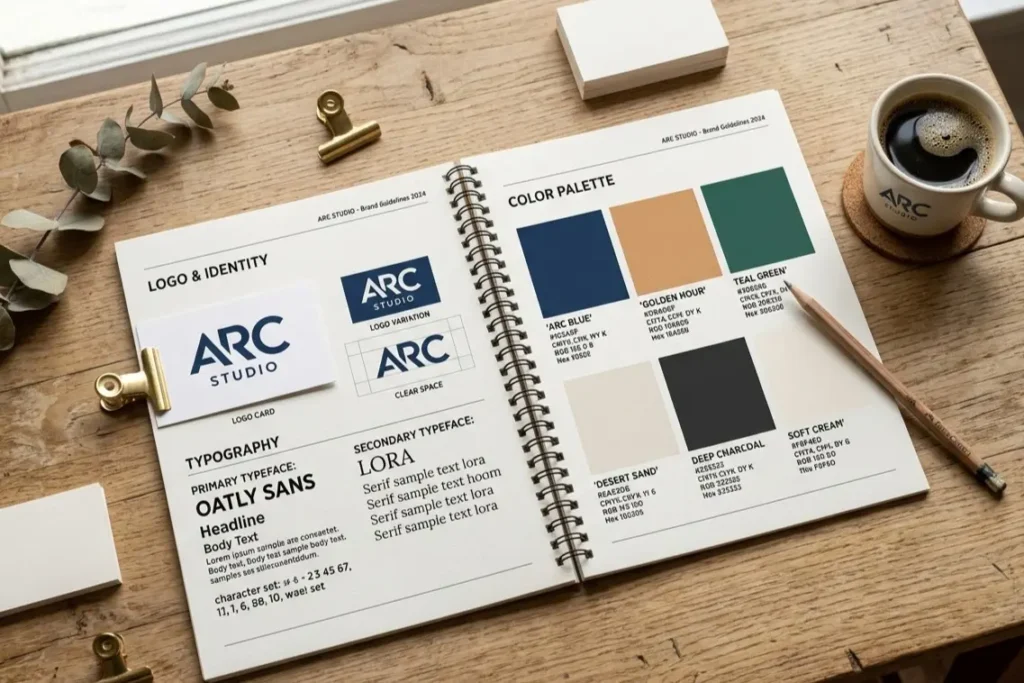
A brand style guide is the document that answers the question “how should this look and sound?” for everyone who works with your brand. Designers. Copywriters. The packaging vendor you hired last month. Your new social media hire.
It covers your logo and every variation of it, your colour codes, your typography choices, your photography direction, and how your brand writes to a customer. Think of it less like a rulebook and more like the briefing you give a team member before they go off and represent your business independently.
Without one, every person who touches your brand interprets it slightly differently. That interpretation drift is quiet and gradual, but it compounds fast.
Why Most Style Guides End Up Unused
We’ve worked with enough Indian startups at Resource Geeks Networks to say this with some confidence: the problem is rarely that the guide is incomplete. The problem is that it was built to impress a client in a presentation, not to be used by a team under pressure on a Tuesday afternoon.
A 50-page brand book in PDF format, full of beautifully designed spreads and abstract voice descriptors like “bold yet approachable,” is not something your social media manager opens when she’s uploading a story at 9pm. She makes a judgment call. And that judgment call, multiplied by a hundred decisions a month across your team, is how brands become inconsistent.
A 2025 branding statistics report found that only 30% of brands have guidelines that are widely used or accessible across their organisation. That number tracks with what we see on the ground here. The fix is not a better-designed PDF. The fix is a guide built for the context in which people actually work.
What to Include and What to Leave Out
A first-version brand style guide does not need to be exhaustive. It needs to be used. Here is what actually earns its place in the document.
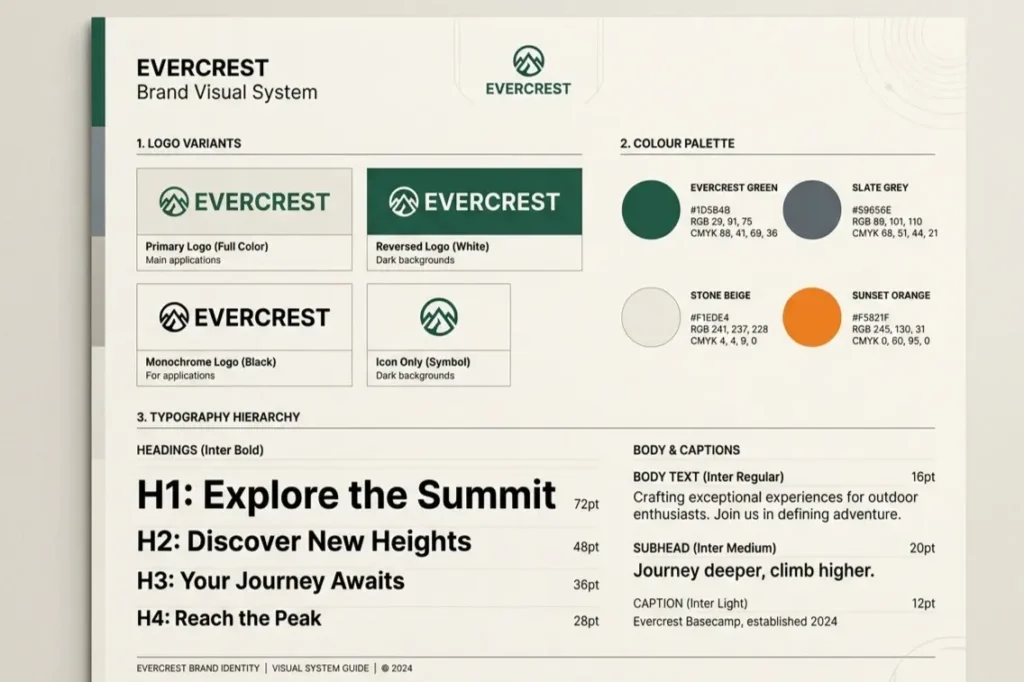
Logo system. Not just the logo file. Show how it behaves. What is the clear space around it? What happens on a dark background? What is the smallest size before it breaks? A logo that only works in one context will cause headaches in every other context.
Colour palette with exact codes. Not “warm red.” HEX #C0392B, RGB 192, 57, 43. The exact codes are what keep your website, your packaging, and your social content feeling like the same brand. Vague colour descriptions are one of the most common reasons brand consistency breaks down.
Typography with actual usage rules. Which font for headings. Which for body copy. Which for pull quotes. And critically, what is the web-safe fallback when your custom font does not load? Most guides skip the fallback. Then the website looks wrong on certain devices and nobody can explain why.
Tone of voice with written examples. This is where most brand guidelines templates completely fail. Writing “we sound confident but warm” tells a copywriter almost nothing useful. What works is a direct comparison. Show a sentence your brand would write and a sentence it would never write, side by side. Three of those examples trains a team faster than three pages of voice descriptors.
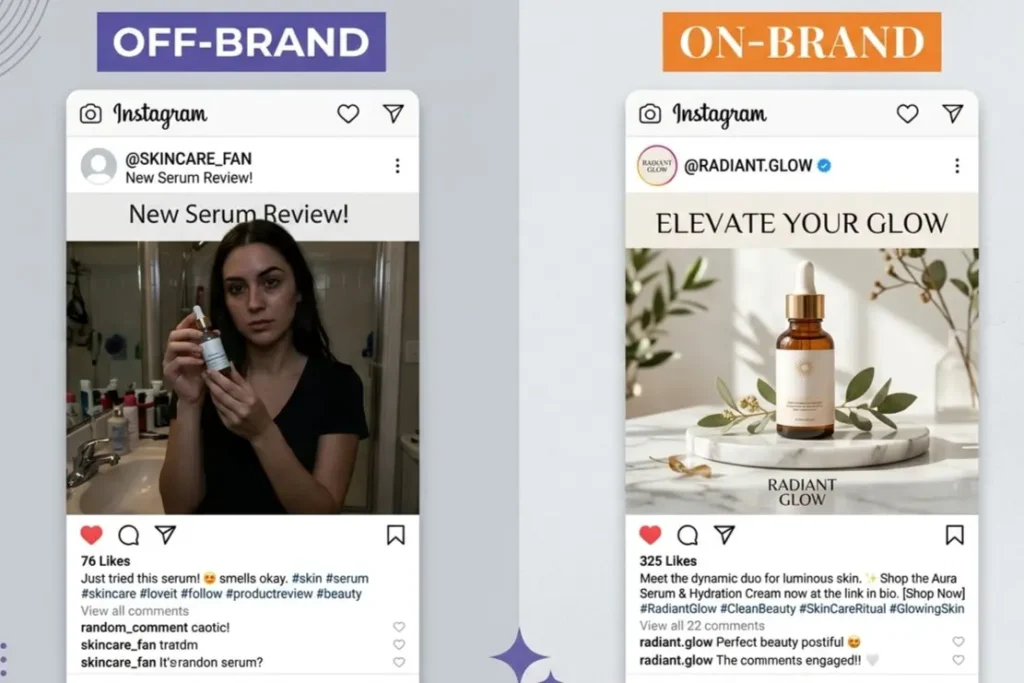
Photography style, custom icons, and social templates belong in the guide but can come in a second version once the foundations are solid. Trying to document everything before anything gets built is one of the more common ways brand style guides never get finished.
How to Create a Brand Style Guide Step by Step
Step 1: Do the audit before you document anything.
Pull everything that currently represents your brand. Website screenshots. Social posts. Packaging files. Business card design. Lay it out and look at it together. Where is it consistent? Where has it drifted? Most teams are genuinely surprised by how much variance has crept in without anyone making a deliberate decision.
Step 2: Write down who you are before anyone opens a design tool.
This is the step agencies skip when they’re trying to move fast and founders skip when they’re trying to keep costs down. Write three things in plain language: who you’re talking to, what you stand for, and what your brand is not. That last one is the most useful. Knowing what you are not makes every subsequent design decision faster and cleaner.
Step 3: Build logo, colour, and typography as a system, not as separate tasks.
A colour palette that looks right in isolation can feel completely wrong next to a particular typeface. At Resource Geeks Networks, we build these three elements together because the interaction between them is where a brand either feels coherent or doesn’t. Commissioning them separately and hoping they work together usually doesn’t work.
Step 4: Write the tone of voice section as if you’re briefing a new hire.
Not a new hire who has design experience. A new hire who has 10 minutes and needs to write a caption for your Instagram post. Short. Opinionated. Real examples from your actual content, not invented ones. If the voice section of your guide could apply to any brand in your category, rewrite it until it couldn’t.
Step 5: Show every element working in a real scenario.
Take your documented logo, colours, typography, and voice and apply them to an actual Instagram post, a website section, a packaging mockup, and a short email. When people can see the guide applied to something they recognise, they use it. When they can only see it described in abstract terms, they don’t.
Step 6: Host the guide where the team already works.
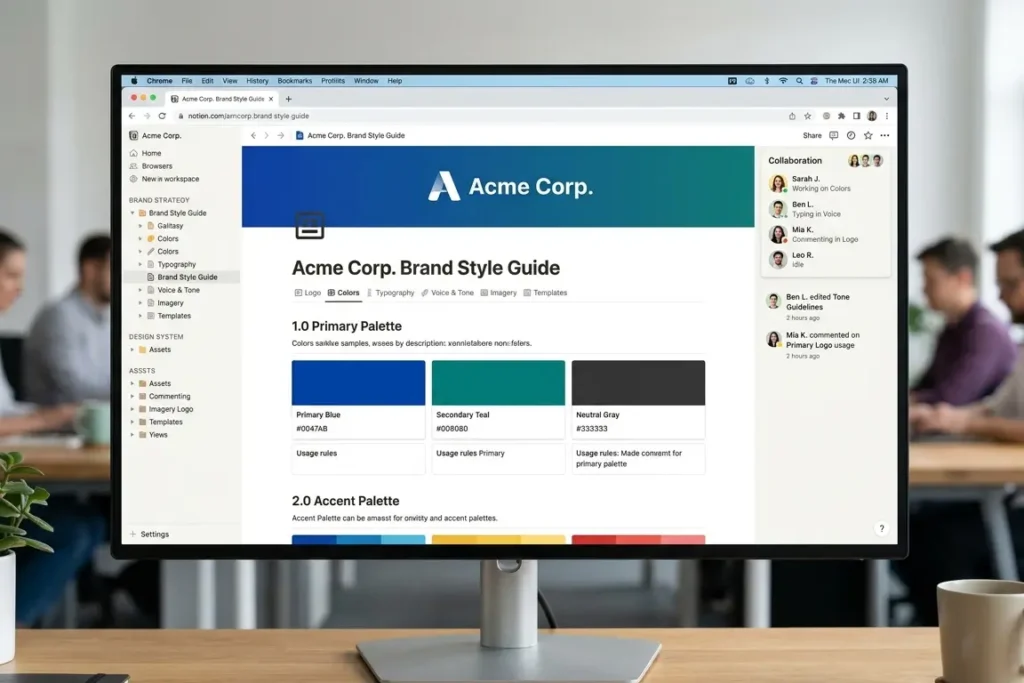
Notion. Figma. A dedicated internal page. Somewhere with a link that anyone can share in a message. A PDF in a folder is not a working document. It is an archive. The guide needs to be the thing people open during the work, not after it.
Step 7: Give the guide to one person to own.
Someone needs to be the person who answers “is this on brand?” and who schedules a quick review once a year. Not a committee. One person. Brands that delegate ownership to everyone end up with the guide being nobody’s responsibility.
The India-Specific Part Nobody Covers
We went through the top five ranking articles on this topic before writing this. All of them cover logo, colour, fonts, voice. None of them address what makes a brand style guide for startups in India genuinely different from one built for a European or American context.
Multi-language consistency. If your brand communicates in Hindi, Tamil, Telugu, or Kannada alongside English, your guide needs to address this directly. How does your logo read when the supporting text is in Devanagari script? Does your tone of voice adapt appropriately when the language changes, or does it sound like a translation that missed the point? This is not an edge case for Indian D2C brands. It is the reality of selling across this market.
Mobile-first brand behaviour. Over 70% of Indian ecommerce traffic comes from phones. Your guide needs to specify how your brand elements behave specifically at mobile dimensions. How does the logo hold up at 90 pixels wide? What is the minimum readable body font size on a six-inch screen? Most global brand guides document desktop applications and treat mobile as an afterthought. For Indian brands, that is exactly backwards.
Regional market adaptation. The visual language and tone that resonates with a buyer in Bengaluru’s startup world may feel cold and overly minimal to someone in Coimbatore or Nagpur. Your guide should document not how your brand changes across regions but how it adapts without losing coherence.
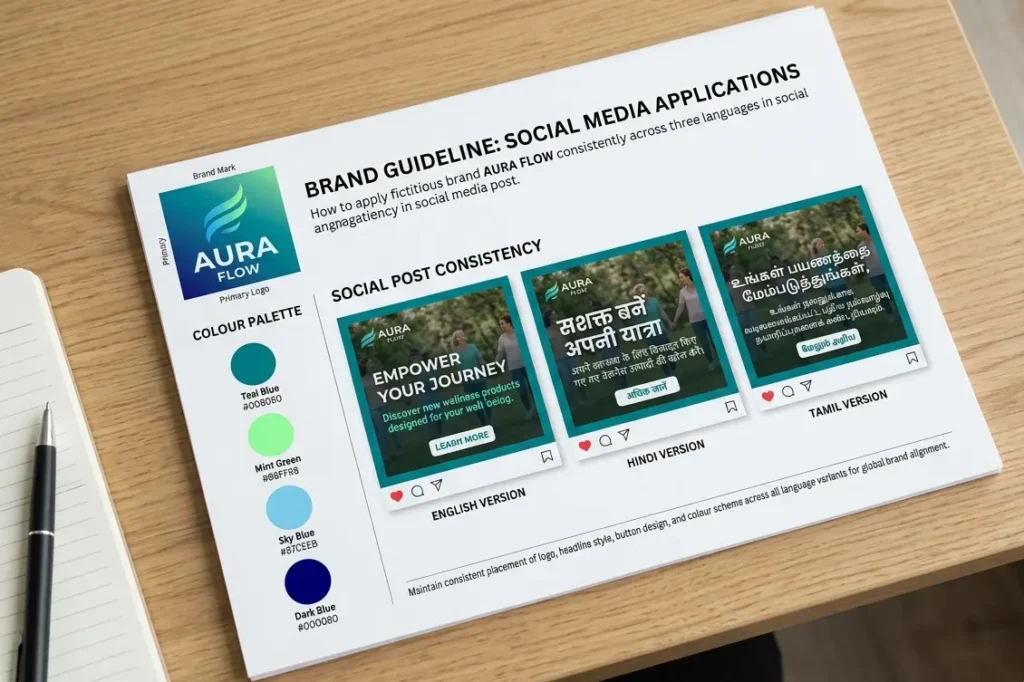
According to VistaPrint’s 2025 Small Business Guide, nearly 39% of Gen Z and Millennial buyers say high-quality, consistent branding is a significant factor in their purchase decision. In a market like India, where that demographic is the core buyer for most D2C brands, inconsistency is not just an aesthetic problem. It has a direct effect on conversion.
Tools That Work in 2026
Figma is the best option for visual-heavy guides. It’s collaborative, version-controlled, and most designers are already in it. Changes update in real time for everyone.
Notion works well for text-heavy documentation and is easier for non-designers to read and search. Good for tone of voice sections, messaging frameworks, and usage rules.
Avoid committing to a static PDF as your primary format. It becomes outdated faster than you think and there is no clean way to update it without creating version confusion.
People Also Ask
How do you make a brand style guide step by step?
Start with a brand audit of everything that currently exists. Define your brand’s audience, positioning, and non-negotiables in plain language before any design work begins. Build logo, colour, and typography as a connected system. Write tone of voice with real comparison examples. Apply everything to actual use cases your team will recognise. Then host the final guide somewhere accessible and assign one person to own it.
What should a brand style guide include?
At minimum: logo variations with spacing and size rules, colour palette with exact HEX and RGB codes, typography with usage hierarchy and web-safe fallbacks, and tone of voice with written examples showing what the brand would and would not say. For Indian brands, add multi-language application guidance and mobile-specific behaviour notes.
How long does it take to create a brand style guide?
A startup-level guide covering the foundations takes two to four weeks with a professional agency. A more comprehensive guide with real-world applications, digital UI guidelines, and multi-language documentation typically takes four to eight weeks depending on scope.
FAQs
What is the difference between a brand style guide and brand guidelines?
They are used interchangeably in most contexts. Brand guidelines is the broader term and sometimes includes strategic positioning. A style guide focuses specifically on execution: how things look and sound in practice, applied to actual outputs.
How much does a brand style guide cost in India?
A startup-level brand guide in India typically costs between Rs. 30,000 and Rs. 1,50,000 depending on scope. A basic document covering logo, colours, and fonts sits at the lower end. A full guide with tone of voice, imagery direction, digital UI guidance, and real-world application examples is usually Rs. 60,000 to Rs. 1,50,000.
Can I create a brand style guide without a designer?
You can write the tone of voice section, the brand values, and the photography direction yourself. The visual system, meaning logo, colour, and typography, genuinely benefits from a designer’s input, particularly if the brand needs to hold up across both print and digital applications.
How often should a brand style guide be updated?
A useful rule is every six to twelve months for an active brand, and immediately whenever a significant product launch, rebrand, or team expansion happens. The guide should grow with the business.
What format should a brand style guide be in?
A hosted, living format works far better than a PDF. A Notion page or Figma share link means the guide is always current. A PDF becomes outdated and ends up circulating in multiple versions on different people’s desktops.
What actually makes a brand style guide get used?
Brevity, real examples, and genuine accessibility. A guide that shows each rule applied to something the team already produces gets referenced. One written in abstract language that describes principles without demonstrating them does not.
What is the first thing to include in a brand style guide for startups in India?
Write the “what we are and what we are not” section before any design element is documented. That clarity is what allows every designer, copywriter, and vendor who works with your brand to make judgment calls that land correctly.
Ready to Build Something Real
Your brand style guide is not a deliverable to check off. It is the infrastructure that keeps everything your team builds feeling like the same brand, whether that is six months from now or three years from now when the team has tripled in size.
At Resource Geeks Networks, we build brand systems and websites as connected projects. The guide, the visual identity, and the digital presence are developed together because building them separately and hoping they integrate cleanly almost never works.
If your brand is inconsistent right now, or you are scaling and need a system that holds up as the business grows, the right time to build it properly is before the problem gets bigger, not after.
Explore our Branding and Strategy services to see how we approach brand system creation, or take a look at our UI UX Design services to see how a brand identity translates into a digital experience that actually converts.
For more on what makes a brand earn trust and drive sales, read our piece on Brand Identity Design Elements That Build Trust and Drive Sales and Branding Agency in Bangalore: Build a Brand That Sells in 2026.