


India’s direct-to-consumer ecommerce space is one of the most mobile-first, payment-diverse, and trust-sensitive markets in the world. Building a store here that actually converts requires thinking about infrastructure, not just marketing.
If your store is getting traffic but not completing sales, you probably already know the feeling. You’ve checked the ads, refreshed the analytics, maybe even changed the homepage banner. None of it moved the number. That’s because most ecommerce conversion rate optimization india advice is written for Western markets where credit cards are default, internet speeds are stable and buyers have been shopping online for fifteen years.
India is a completely different game.
What Ecommerce Conversion Rate optimization Actually Means in India
There’s a version of this conversation we have with almost every D2C founder we work with. They’ve spent money on Meta, got decent traffic, and still see a conversion rate sitting somewhere between 0.8% and 1.2%. They want to know what’s wrong with the creatives.
The creatives are usually fine.
Ecommerce conversion rate optimization india is really about removing friction from the point a buyer lands on your store to the point they complete payment. And in India, the friction isn’t where global CRO guides say it is.
India accounts for over 95% of mobile traffic running on Android devices, and mobile commerce already drives 62% of all retail ecommerce sales in the country. That means your store’s performance on a mid-range Android device, on a 4G connection with variable signal, is essentially your conversion rate. Everything else is secondary.
The brands getting this right aren’t spending more on ads. They’re spending more on the build.
Why Is My Ecommerce Conversion Rate Low in India?
Let’s be honest about what’s actually happening when buyers abandon. The most common reasons are engineering decisions that got deprioritised at launch, not marketing gaps.
Slow mobile load times on real-world networks
Your store might load in 1.2 seconds on a MacBook connected to office Wi-Fi. It loads in 4.8 seconds on the device your customer is actually using. Pages loading in around 2.4 seconds had a 1.9% conversion rate, but when load time crept to 5.7 seconds or more, conversion rate fell to 0.6%. That’s a 68% drop from page speed alone.
Forced account creation before checkout
Almost 26% of shoppers will abandon their carts if forced to create an account before checkout. Guest checkout isn’t a nice-to-have. It’s a conversion requirement.
Missing or buried UPI options
13% of users abandon carts if they don’t see their preferred payment option. In India, that preferred option is almost always UPI. If it’s not visible at the top of your payment screen, you’re losing buyers who’ve made up their minds to purchase.
Hidden costs appearing at checkout
Shipping charges, GST or handling fees that only appear at the final step create what’s called checkout shock. A buyer who was ready to pay now has to reconsider. Most don’t. They close the tab.
We covered the product page side of this in detail in our piece on product page design for higher conversions, because fixing the pre-checkout experience matters just as much as fixing checkout itself.
The Checkout Audit: 7 Fixes That Directly Impact Revenue
This is the section most global CRO guides skip because they’re not writing for your market. Consider this your ecommerce cro checklist for indian d2c brands, ranked roughly by impact.
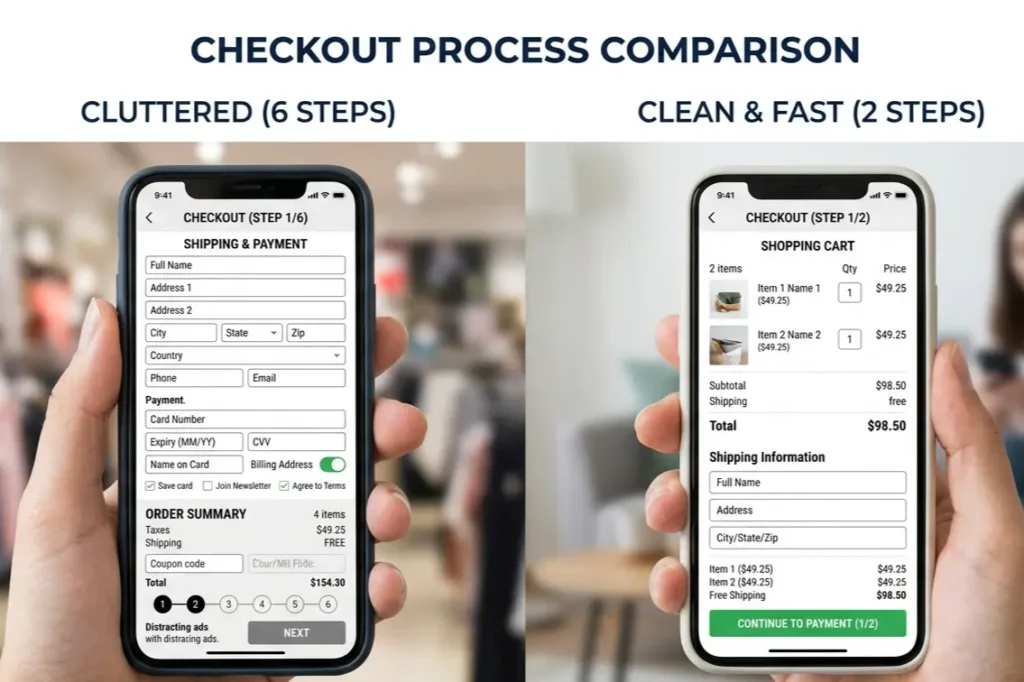
1. Enable guest checkout without negotiation
Account creation belongs after the purchase, not before it. Offer to save their details once payment is confirmed. That’s the moment they trust you.
2. Reduce your checkout to three steps maximum
Address, payment, confirmation. Anything beyond that is a reason to leave. We’ve audited stores with seven checkout steps. They wonder why conversion rate is low in India.
3. Surface UPI at the very top of the payment screen
Not buried in a dropdown. Not listed below cards. UPI and digital wallets commanded nearly 50% of India ecommerce transaction volume in 2025. Your payment UI should reflect that reality.
4. Show real-time shipping costs before the final step
The moment a buyer sees an unexpected fee, the mental accounting restarts. Show costs at the cart stage. Let them make the decision early rather than abandoning late.
5. Add a sticky order summary
Buyers on mobile can’t scroll back easily. A persistent mini-summary with product image, name and price keeps confidence high through the checkout.
6. Use UPI intent flow, not collect flow
Prioritising UPI Intent Flow (app-to-app) over Collect Flow can boost UPI payment success rates to approximately 98% by eliminating context-switching and bypassing bank server downtime. This is a backend decision that most brands never make.
7. Optimise every form input for mobile keyboards
Pin code fields should open numeric keyboards. Name fields should have autofill enabled. Nothing should require a user to zoom in to see what they’re typing.
If you’re still evaluating which platform to build on before making these decisions, the comparison in our ecommerce website development india guide covers Shopify and WooCommerce from a CRO infrastructure perspective.
Page Speed Is a CRO Problem, Not a Technical One
We hear this often from founders. “Page speed is a developer thing, not a conversion thing.” It’s both. But when you’re asking how to improve ecommerce conversion rate, page speed is usually the fastest route to measurable results.
Mobile cart abandonment in India is projected to hit 85% by 2026, primarily driven by network latency and packet loss in Tier 2 and Tier 3 cities rather than just poor UI design.
The fixes that actually work are development decisions. Lightweight theme architecture over bloated page builders. Next-generation image formats like WebP. Lazy loading for media below the fold. Reducing third-party script load on the checkout page specifically.
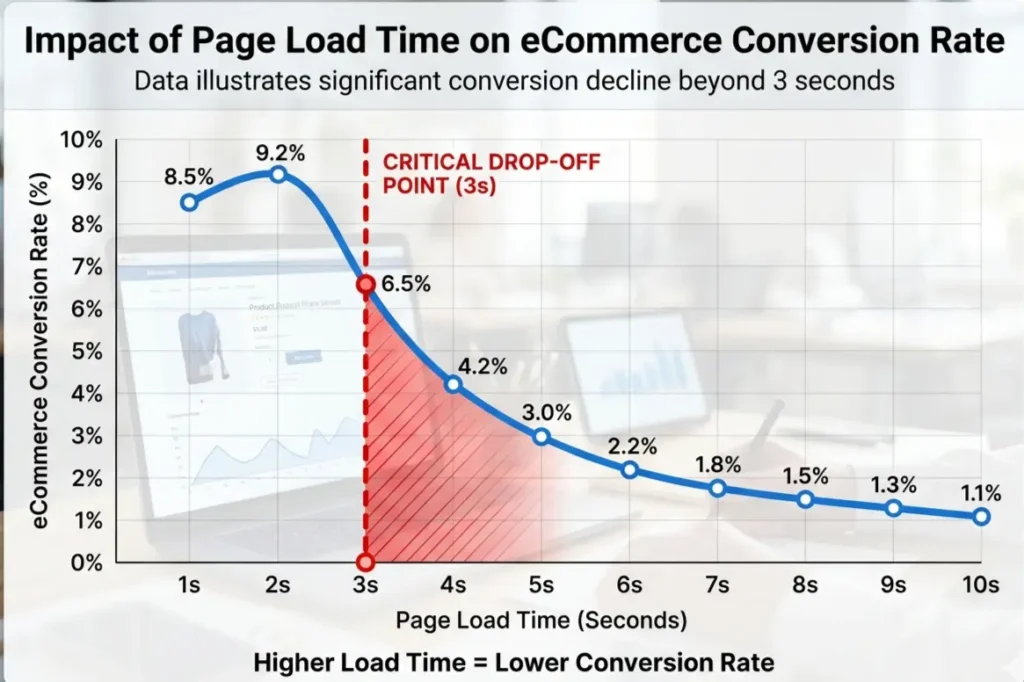
This is why we think of CRO as infrastructure. When you build conversion performance into the codebase from day one, you don’t need to retrofit it later with plugins and patches. Our D2C website features that support conversion piece goes into the specific technical choices that make the biggest difference at build stage.
Trust Signals That Indian Buyers Actually Respond To
Indian consumers are careful. This is especially true for D2C brands that aren’t Nykaa or Mamaearth. A first-time buyer has no reason to trust your checkout page unless you give them one.
What actually works is more specific than most CRO guides acknowledge.
Customer reviews with photos, not just star ratings. A visible return policy that’s one click away from the product page, not buried in the footer. A WhatsApp support link or a visible phone number. COD as an option, particularly for buyers in Tier 2 and Tier 3 cities who’ve been burned by non-delivery before. Payment security badges placed near the confirm order button.
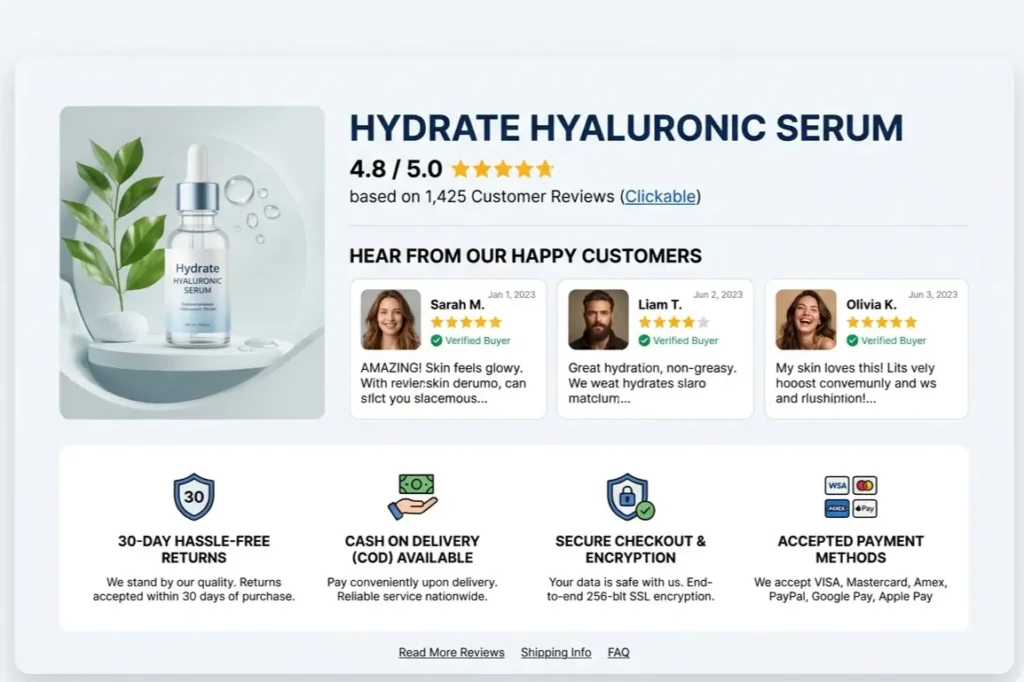
Indian buyers rely heavily on mobile devices, expect diverse payment methods such as UPI and Cash on Delivery, and evaluate trust signals more carefully than shoppers in many Western markets.
This isn’t a design observation. It’s a conversion lever. Every trust element you add above the fold reduces the hesitation that kills a sale.
Payment UX: How UPI and BNPL Raise Average Order Value
Most D2C brands think about payment as the final step. The brands with higher average order values think about it much earlier.
Buy Now Pay Later is a good example. When a buyer sees a ₹2,400 product, they’re doing mental maths. When they see “4 payments of ₹600” next to the price, that mental maths changes entirely. The product becomes more accessible. BNPL often boosts conversion rates and average order value by making expensive items seem more affordable.
The same principle applies to UPI on credit. Credit on UPI, enabled through RuPay credit cards, has expanded average ticket sizes. RuPay now accounts for 16% of India’s credit card spending.
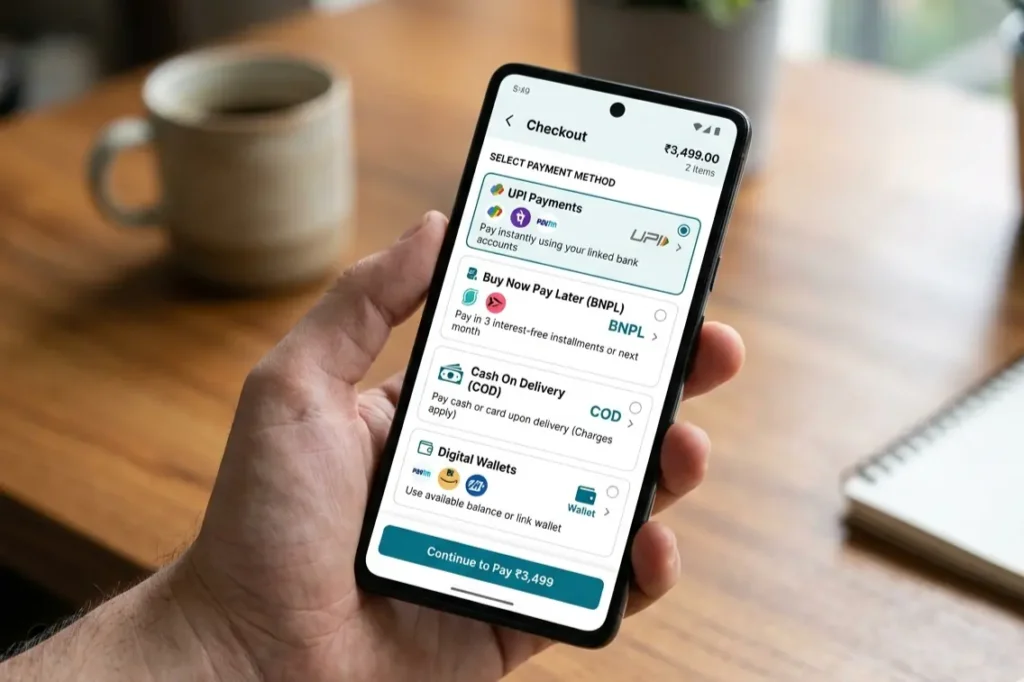
The practical ecommerce checkout optimization india move here is to surface BNPL options at the product page level, not just at checkout. Let buyers see affordability before they even add to cart.
What Conversion Metrics Are Normal in India
One of the things that makes my ecommerce conversion rate low in India such a common search is that founders are benchmarking against global averages. Global averages don’t apply here.
The 2026 Conversion Benchmark Report shows India’s ecommerce conversion rate in fashion at 1.2%, compared to 1.7% in the US, reflecting the market’s earlier stage of optimization. The average Indian ecommerce conversion rate ranges between 1.5% and 2.5%, while cart abandonment often exceeds 70%.
A well-optimised store in India, with strong mobile performance, clean checkout and proper payment UX, can reach 2.5% to 3.5%. Stores that have been through a proper CRO build rather than a standard theme launch regularly outperform those benchmarks.
Key metrics to track per checkout step. Device-split conversion, especially mobile versus desktop. UPI payment success rate specifically, because a failed UPI transaction is a lost sale that your overall conversion rate hides. Cart abandonment rate by traffic source, because paid traffic and organic traffic behave differently.
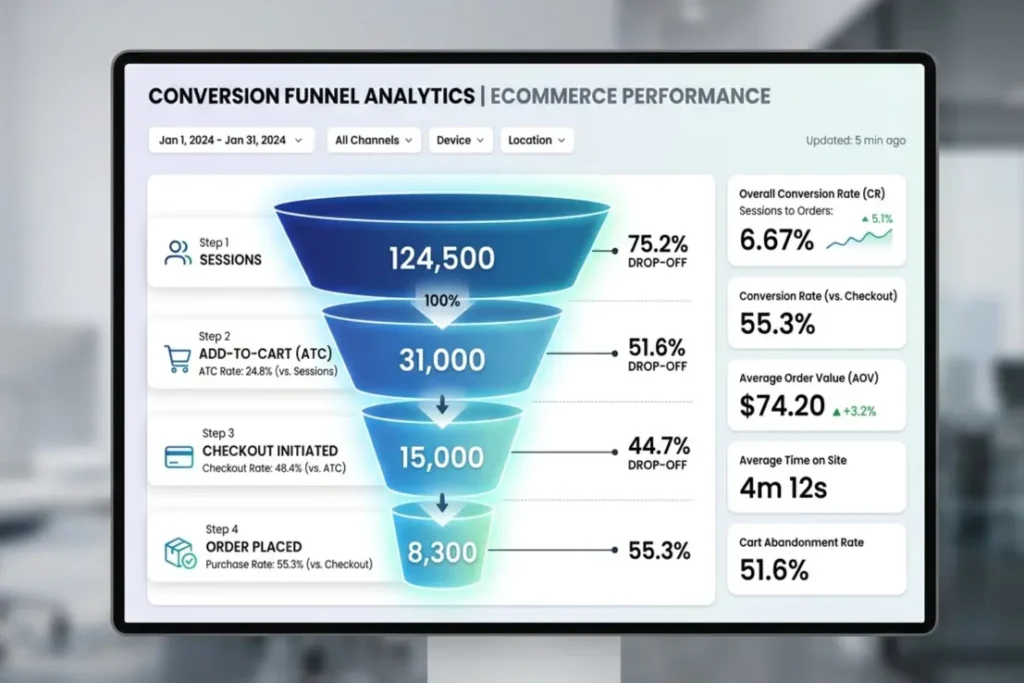
According to a report by Upgrowth, businesses that implement systematic CRO in the Indian context can improve conversion rates by 20 to 40% without increasing traffic at all. The lever isn’t acquisition. It’s what happens after someone lands.
FAQs
What is a good ecommerce conversion rate in India?
A reasonable benchmark for an Indian D2C store is between 1.5% and 2.5%. A well-optimised store with strong mobile UX, proper payment options and clean checkout architecture can reach 3% or higher. The national average is lower than Western markets because most stores haven’t been built with CRO infrastructure in mind.
How do I reduce cart abandonment on my Indian ecommerce store?
The highest-impact changes are enabling guest checkout, showing shipping costs before the final step, surfacing UPI at the top of the payment screen, and reducing checkout to three steps or fewer. Hidden costs at checkout and forced account creation are the two leading reasons Indian buyers leave before completing payment.
Does page speed actually affect ecommerce conversions in India?
Yes, more so than in most other markets. Because the majority of Indian shoppers are on mid-range Android devices with variable mobile data, page load time has a direct and measurable impact on whether a sale completes. A one-second improvement in load time can meaningfully increase conversion rate, particularly on checkout pages.
What payment options should an Indian ecommerce store offer?
UPI (including Google Pay, PhonePe and Paytm), Cash on Delivery for Tier 2 and Tier 3 audiences, Buy Now Pay Later for higher-ticket products, digital wallets, and cards. Missing UPI is the single biggest payment-related conversion killer in the Indian market.
What is BNPL and how does it increase average order value in India?
Buy Now Pay Later splits a purchase into smaller instalments. For Indian D2C brands selling products priced above ₹1,500, BNPL shifts the buyer’s mental calculation from “can I afford this” to “can I afford ₹500 per month.” This directly raises the proportion of buyers who complete checkout on higher-value items.
Your Store Is Getting Traffic. It Deserves to Convert.
If you’ve read this far, you already know the problem isn’t awareness. It’s the build.
At Resource Geeks Networks, we design and develop ecommerce stores where CRO isn’t a post-launch audit, it’s part of the architecture from day one. That means faster mobile load times, checkout flows built around Indian buyer behaviour, UPI integration done properly, and trust signals placed where they actually change decisions.
We’ve done this for D2C brands in skincare, wellness, fashion and home products across India. The stores we build convert better because they’re engineered to.
If your store is leaving sales on the table, visit resourcegeeksnetworks.com to start a conversation about what a conversion-ready build actually looks like for your brand.