Every year, thousands of Indian businesses invest in marketing, hire great sales teams, and refine their offerings only to watch potential customers quietly leave from their website. No inquiry. No call. Just a bounce.
We’ve worked with enough businesses to know that the website is almost always where the trust breaks down first. And the frustrating part? Most of those businesses didn’t have a bad product. They had a bad website development services experience one that prioritised how things looked over how things worked.
This guide is for anyone who’s tired of that story.
What Is Website Development?
Let’s start with the basics because a lot of people think website development is just about making something that looks nice. It’s really not.
Website development services covers the entire process of building a functional, performant, and user-ready website. That includes the design, the code, the database logic, the speed optimisation, the security layers, and the ongoing maintenance that keeps everything running after launch. It’s the full picture, not just the surface.
Think of it like building a shop. You wouldn’t just care about the signboard and the paint on the walls. You’d care about the layout, the lighting, how easy it is for customers to find what they’re looking for, and whether the billing counter actually works when it needs to. A website is exactly that just digital.
Why Your Business Can’t Afford a Bad Website
Here’s a story we hear often. A business owner invests months into developing a new service. They’ve done the research, refined the offering, even ran a few successful pilots. Then they launch and the leads just… don’t come.
After some digging, the real issue surfaces. The website takes nearly 6 seconds to load on mobile. The contact form doesn’t work properly on certain devices. The homepage is beautiful on a desktop but completely broken on a phone. And over 60% of their audience in India is browsing on mobile.
That’s not a marketing problem. That’s a web development company problem.
Google’s Core Web Vitals have made page speed and user experience a direct ranking factor. A site that loads slowly, behaves inconsistently, or feels outdated doesn’t just frustrate users it gets buried in search results. And once you’re buried, even the best content and the best product won’t save you.
Types of Website Development
Not all development is the same, and choosing the right type for your business needs can honestly save you a lot of time and money down the line.
Our frontend development services is what your visitor experiences the moment they land the layouts, the buttons, the animations, and how the site responds across different screen sizes. When frontend is done right, users don’t notice it. They just feel comfortable. When it’s done poorly, they leave within seconds and they can’t always tell you why.
Then there’s the backend. Our backend development services is the part of your website that users never see but depend on completely the servers, the databases, the APIs, the logic that lets your site actually do things. Process a booking. Handle a login. Store customer information securely. Without strong backend work, the prettiest frontend in the world is essentially a brochure.
Full Stack Development brings both together. It’s the approach most growing businesses genuinely need and it’s how we tend to work at Resource Geeks Networks when clients want a complete, end-to-end solution as part of our professional website development services.
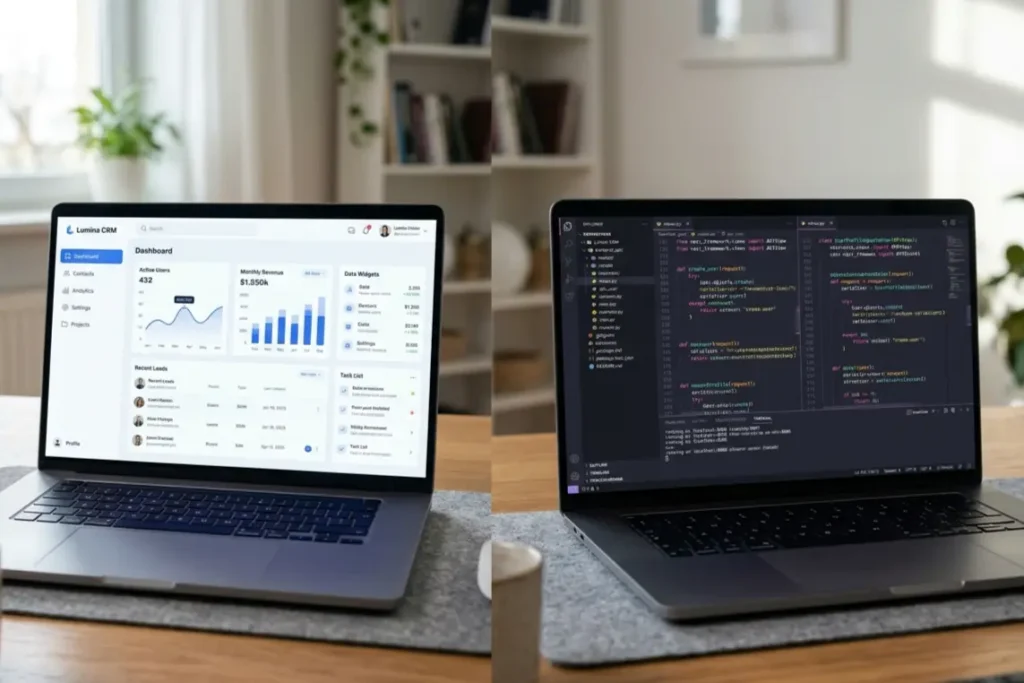
Image Suggestion 1: A side-by-side split image showing a clean frontend UI design on a laptop screen alongside a backend code editor on a dark screen. Alt text: Frontend and backend website development process shown side by side
Custom vs Template: What Nobody Tells You
Okay, let’s be real for a second.
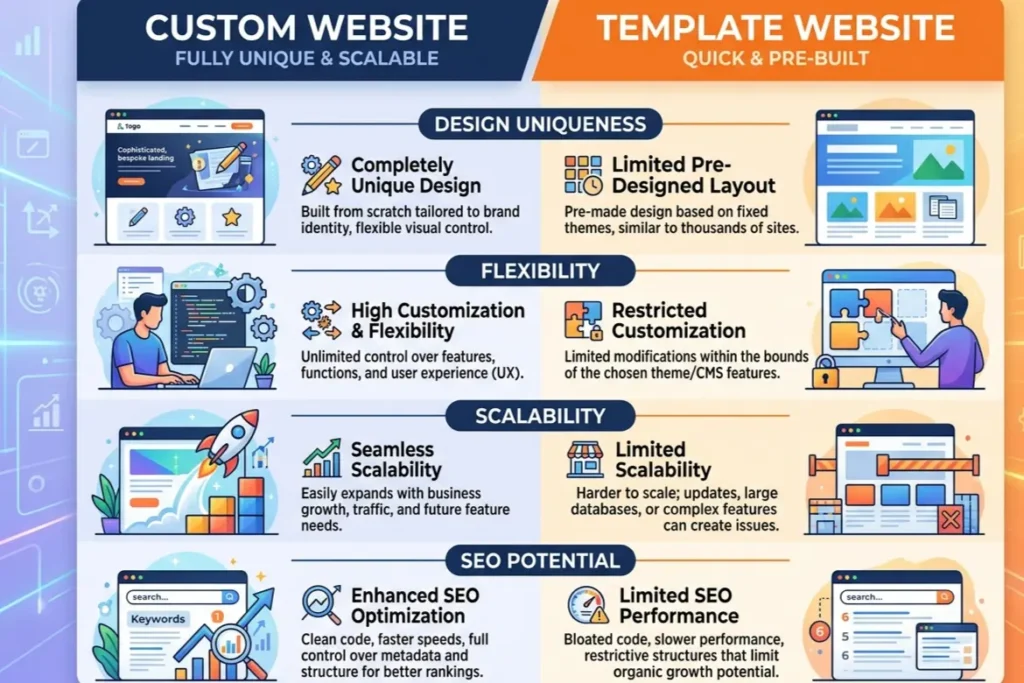
Most agencies will steer you toward a template-based website. And to be fair sometimes that’s the right call. If you’re an early-stage business, working within a tight budget, and just need something functional and online quickly, a well-configured WordPress theme can genuinely work.
But here’s what those same agencies often don’t tell you. Template sites are built for everyone. Which, practically speaking, means they’re optimised for no one in particular. You’re sharing a structure, a logic, and often a look with hundreds of other businesses. And the moment your needs grow beyond what the template allows which always happens eventually you’re either rebuilding from scratch or working around limitations that frustrate your users every single day.
Our custom website development services starts from your business goals, not from a pre-existing design library. The user flow, the features, the performance benchmarks everything is built around what your customers actually need to do on your site. For startups scaling quickly, for ecommerce businesses with complex inventory needs, or for service companies that want a website that genuinely reflects their positioning custom is almost always the smarter long-term investment.
How Long Does It Take to Build a Website for a Business?
Honestly? This is the question almost every client asks first, and it’s one of the most misleading questions in the industry because the answer varies so much that a straight answer without context is almost useless.
A clean, well-designed informational website with proper SEO foundations can realistically go live in 3 to 4 weeks. A business website with a CMS, lead capture forms, a blog, and integration with third-party tools usually takes somewhere between 5 and 8 weeks. A full ecommerce build one with payment gateways, product management, a customer dashboard, and proper security that’s a 10 to 16 week project at minimum, if it’s being done properly.
What actually slows most projects down isn’t the development work itself. It’s the unclear briefs at the start, the content that isn’t ready when development begins, and the rounds of revisions that keep expanding because no one agreed on the scope upfront. We’ve seen projects double in duration not because of technical complexity but because of avoidable communication gaps.
Any agency that’s promising a full business website in 5 days is cutting corners. Usually in testing. Sometimes in security. Often in both.
The Website Development Process at Resource Geeks Networks
We’ve worked with businesses across India from early-stage startups trying to get online for the first time, to established companies that had outgrown their old website and needed something built for the next chapter. And over time, we’ve developed a process that’s thorough without being rigid.
It starts with Discovery and Planning. Before we open a design tool or write a single line of code, we spend time understanding what your business actually needs. Who is your customer? What do you want them to do when they land on your site? What’s currently working, and what isn’t? These conversations take time, but they’re the difference between a website that looks good in a presentation and a website that performs in the real world.
From there, we move into UI/UX Design. This is where our UI UX design for websites comes in and its where a lot of agencies quietly cut corners. Design isn’t just aesthetics. It’s the path a user takes from first landing on your site to completing the action you want them to take. Every layout decision, every button placement, every piece of white space it’s all intentional. Or it should be.
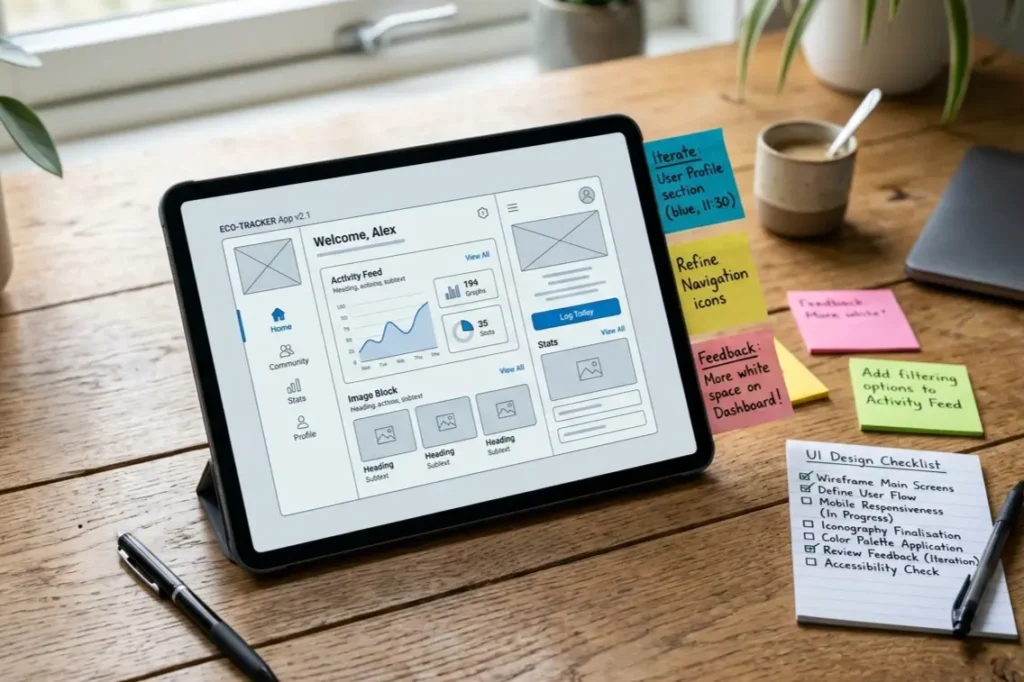
Then comes Development clean, scalable code built without shortcuts that creates problems six months later. Followed by Testing, where we deliberately try to break things so your users don’t have to. Cross-device, cross-browser, speed, security all of it.
And then there’s Launch. Which, for us, is really just the beginning of a different phase. Our website maintenance services handle everything that happens after go-live the regular updates, the security patches, the performance monitoring, and the small fixes that keep a site running smoothly over time. Because a website that isn’t actively maintained is a website that’s slowly falling behind.
Technologies We Use
We work with what the project actually needs not just what we’re most comfortable with.
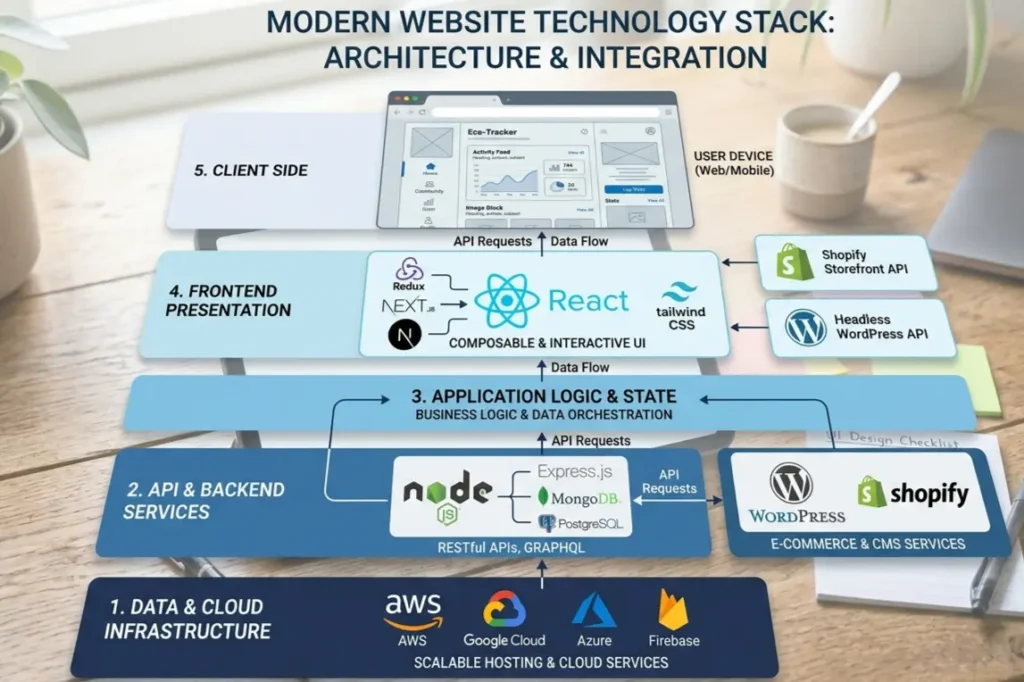
On the frontend, that typically means HTML5, CSS3, and JavaScript frameworks like React or Vue depending on the complexity and interactivity required. On the backend, we work with Node.js, PHP, and Python. For content management, we lean toward WordPress for most business sites and custom headless CMS setups when clients need content flexibility without sacrificing load speed.
For ecommerce, our ecommerce website development work spans WooCommerce, Shopify, and fully custom builds. Which one we recommend depends entirely on your order volume, catalogue size, and where you expect to be in two years not on which platform is easiest for us to build on.
SEO, Performance & Security Built In, Not Bolted On
One of the most common mistakes we see is businesses treating SEO as an afterthought something to be added once the website is already live. By that point, you’re already fighting an uphill battle. The structural decisions that affect how Google reads and ranks your site are made during development, not after.
We build with SEO in mind from the very first line of code. That means clean heading hierarchy, proper schema markup, Core Web Vitals optimisation, mobile-first indexing, compressed images, and logical URL structures all before content even enters the picture.
Performance isn’t optional either. A website development agency that isn’t talking about Largest Contentful Paint, First Input Delay, and Cumulative Layout Shift in 2025 is working with an outdated playbook.
And then there’s security SSL certificates, regular updates, encrypted data handling, secure payment integrations. These aren’t premium add-ons. They’re the floor, not the ceiling.
It’s worth noting that AI search engines like Google AI Overview and ChatGPT are increasingly surfacing content from websites that are structurally clean and semantically clear. That means well-organised headings, FAQ schema, and direct answers to real user questions which is exactly how we approach every build.
What Should I Look for When Hiring a Website Development Agency?
Start with their portfolio, not their pitch deck. A well-crafted sales presentation can hide a lot but past work rarely lies. Look for variety, for performance results, and for projects that are similar to what you’re trying to build.
Ask specifically about post-launch support. A lot of agencies are excellent at the build phase and then essentially disappear once the site is live. That’s a problem. Your website will need updates, security patches, and performance monitoring over time and the agency that built it is always best placed to handle that work.
Ask for transparency on timelines and pricing before you sign anything. Vague quotes almost always lead to scope creep, delayed launches, and uncomfortable conversations. A good website design and development partner gives you a clear breakdown upfront not a ballpark figure that doubles by the end.
And perhaps most importantly: pay attention to how many questions they ask before quoting. An agency that sends a proposal after a 15-minute call hasn’t understood your business. We ask a lot of questions at Resource Geeks Networks. Always have. It’s not inefficiency it’s how we make sure we’re building the right thing.

FAQs
What is included in website development services?
Website development services covers the full lifecycle of building a website from initial planning and UI/UX design, through frontend and backend development, to testing, launch, and ongoing maintenance. At Resource Geeks Networks, that also includes SEO foundations, mobile optimisation, security configuration, and performance tuning from day one not as extras, but as standard parts of how we build.
How much does website development cost in India?
A basic static website typically starts from Rs. 10,000, a dynamic business website from around Rs. 25,000, and a full ecommerce build from Rs. 35,000 upward depending on the features required, the level of customisation, and the complexity of integrations. The honest answer is that cost follows scope. Before committing to any agency, always ask for a line-by-line breakdown so you know exactly what you’re paying for.
What is the difference between custom and template website development?
Template websites uses pre-built designs; they’re faster to launch and typically more affordable upfront, but they limit how much the site can be tailored to your specific needs. Custom website development builds everything from scratch, around your goals, your users, and your growth plans. For businesses that are serious about long-term performance, custom is almost always the better investment.
Why Choose Resource Geeks Networks
We’re an Indian website design and development team and that context matters more than it might seem. We understand the Indian market, the budget realities most businesses are working within, the pace at which things move, and the kind of digital competition that’s shaping buying decisions right now.
We don’t outsource the work you bring to us. Every project gets a dedicated team, a process that’s been refined over years of real projects, and an output that’s measured against your conversion goals, not just your design preferences.
Whether you’re a startup needing affordable custom website development services, a growing business ready to move into ecommerce, or an established company whose website has quietly stopped performing, we’ve done this work before, and we know how to do it well.
Ready to build something that actually works for your business? Visit https://resourcegeeksnetworks.com/ and let’s start the conversation.