


The Indian ecommerce space is one of the fastest-moving in the world right now. New D2C brands are launching every single week, and the platform you build on will shape your costs, your flexibility, and your margins for the next three to five years.
So before you fire up Shopify’s free trial or ask a developer to just set up WooCommerce, let’s actually answer the shopify vs woocommerce india question the way it deserves to be answered: through Indian pricing, Indian payment gateways, and what actually works for Indian buyers.
We’ve built stores on both. Here’s the honest version.
Why Platform Choice Is a Bigger Deal in India
Here’s something the global comparisons miss entirely.
In the US or UK, you pick Shopify and you’re done. Shopify Payments handles your checkout, transaction fees are waived, and setup takes a weekend. In India, that exact same scenario costs you an extra 2% on every single sale because Shopify Payments is not available here.
That is not a minor footnote. For a store doing Rs. 5 lakh a month in revenue, that’s Rs. 10,000 gone every month before you’ve even touched marketing, logistics, or returns.
According to a 2026 analysis by rajeshrnair.com, on a store generating Rs. 50 lakh per year, the difference in gateway and plan combinations alone can mean Rs. 50,000 to Rs. 3,00,000 in annual cost variation. That is a developer’s monthly retainer, just gone into fees.
The best ecommerce platform india for your brand is not the one with the best marketing. It is the one where the cost math makes sense at the revenue stage you are actually at.
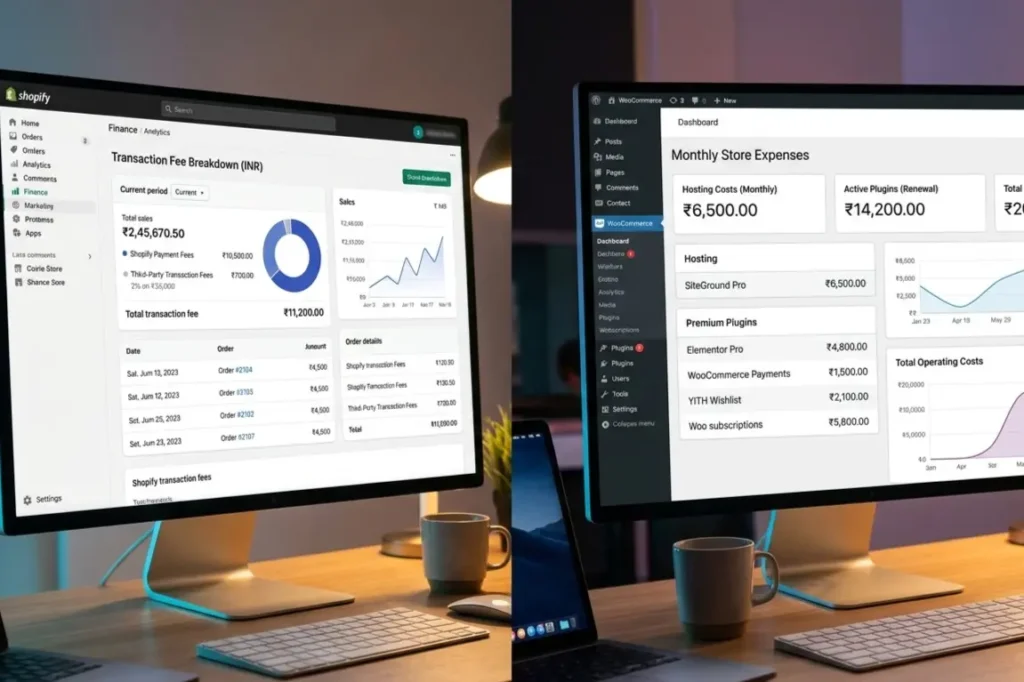
Shopify in India: Real Costs and Trade-offs
Let’s start with what Shopify actually costs an Indian store in 2026.
The Basic plan runs Rs. 1,994 per month with annual billing. The mid-tier Grow plan sits at Rs. 5,599 per month. Both figures include 18% GST, which most articles conveniently do not mention.
Here’s where it gets India-specific. Since Shopify Payments is not available in India, every Indian merchant using Razorpay, PayU, or Cashfree pays Shopify an additional transaction fee on top of the gateway’s own fee. On the Basic plan, that’s 2%. On the Grow plan, it drops to 1%. On Advanced, 0.5%.
So on the Basic plan, your actual payment processing cost per sale looks like this: 2% Shopify transaction fee plus 2% Razorpay platform fee plus 18% GST on fees equals roughly 4.3 to 4.5% of every order value. On a Rs. 1,000 order, that’s Rs. 43 to Rs. 45 before you’ve paid for shipping or packaging.
What Shopify genuinely gets right for Indian brands is speed. We’ve had clients live and take orders in under 10 days. Razorpay and UPI are set up in hours, not days. The hosted infrastructure means no security patches, no server crashes, no plugin conflicts. For a first-time founder without a technical co-founder, that peace of mind is worth real money.
The ceiling hits when you want to go off-script. Custom checkout flows, complex discount logic, WhatsApp checkout, or a Tier 2-optimised experience that genuinely does not look like every other Shopify store. At that point, you’re either paying for premium apps ranging from Rs. 3,000 to Rs. 15,000 per month or accepting limitations.
WooCommerce in India: What Ownership Actually Means
WooCommerce is free. That sentence is technically true and practically misleading.
What WooCommerce is: a free plugin that runs on WordPress. What you actually pay for is everything around it. Managed WordPress hosting costs Rs. 800 to Rs. 4,000 per month depending on traffic. You also need an SSL certificate, a premium theme for custom development, the Razorpay WooCommerce plugin which is free and well-maintained, Yoast or Rank Math for SEO, and a developer when something breaks.
The reason WooCommerce wins long-term for established Indian D2C brands is data ownership and zero platform tax. There is no Shopify sitting between you and your customer. No 2% off every order. Your data lives on your server, your customer email list is fully yours, and the WooCommerce-Razorpay integration is one of the cleanest in the ecosystem.
For a brand doing Rs. 10 lakh per month in sales, the math usually flips. The monthly WooCommerce operational cost covering hosting, maintenance, and one developer day per month often comes in lower than the equivalent Shopify plan plus transaction fees plus essential apps.
The honest trade-off: WooCommerce needs someone to care for it. Updates need testing. Plugin conflicts happen. If you don’t have a technical team or a reliable agency, a WooCommerce store will degrade slowly and quietly until something breaks publicly. We’ve seen this happen, usually around the 12 to 18 month mark.

Head-to-Head: 8 Decision Factors for Indian Brands
For those searching which ecommerce platform is best for small business india, here is the honest answer filtered through 8 real factors.
1. Setup Speed Shopify wins. 10 to 14 days to a live store without a developer. WooCommerce with custom design takes 4 to 8 weeks.
2. Monthly Cost at Rs. 5 Lakh Per Month Revenue WooCommerce typically wins. Shopify on the Grow plan plus Razorpay fees comes to Rs. 20,000 or more per month. WooCommerce total operational cost sits at Rs. 8,000 to Rs. 14,000 per month.
3. Payment Gateways Both integrate well with Razorpay, Cashfree, and PayU. WooCommerce plugins are free. Shopify apps may carry monthly fees. Neither supports Shopify Payments natively in India.
4. GST Compliance WooCommerce with a GST plugin handles Indian invoice generation, HSN codes, and tax reports cleanly. Shopify requires a paid app for proper GST compliance. This matters more than most founders realise until tax season arrives.
5. SEO WooCommerce on WordPress is the stronger SEO platform. It gives you full URL control, schema markup, Yoast and Rank Math integration, and proper blog architecture. Shopify has built-in SEO basics but canonical tag limitations and URL structure rigidity can create friction at scale.
6. COD Management Both platforms support COD. WooCommerce plugins give more control over conditional COD logic, such as blocking COD by PIN code or showing a prepaid discount prompt. Shopify handles this through paid apps.
7. Scalability Shopify handles traffic spikes natively since the hosting scales without your involvement. WooCommerce on good managed hosting like Cloudways or Kinsta can match it, but you are responsible for ensuring that setup is properly configured.
8. Vendor Lock-in WooCommerce gives you zero lock-in. Your data, your code, your hosting choice. Shopify carries significant lock-in. Migrating away means rebuilding a lot from scratch, and some data like order history does not export cleanly.

Which Platform for Which Indian Business Type
We answer this question almost daily at Resource Geeks Networks. The honest version is that Shopify is better or WooCommerce always wins. It is this:
Build on Shopify if: You are launching your first store and speed matters more than cost optimization. You do not have a developer on the team. You are testing product-market fit before committing to a full build. Your monthly revenue is under Rs. 2 to Rs. 3 lakh and you want simplicity over savings.
Build on WooCommerce if: You are already doing revenue and the transaction fees are biting. You need GST invoicing, regional language support, or complex discount logic. You want full data ownership. You have access to a reliable development partner who will manage maintenance.
Choose custom ecommerce development if: Your business model does not fit either platform cleanly. This includes B2B pricing tiers, multi-vendor setups, ERP integrations that need to be bulletproof, or a subscription model with complex billing logic. Our ecommerce website development india work sits here for brands that have outgrown templates.
Most of the D2C stores we’ve built in the Rs. 60,000 to Rs. 1,50,000 range start on WooCommerce. Most of the fastest launches, where founders have a deadline and no tech team, go on Shopify. The platform follows the founder’s situation, not the other way around.
The Hidden Fee Nobody Warns You About
This is the one section most shopify vs woocommerce india articles skip entirely.
When you are on Shopify’s Basic plan and using Razorpay, which is the setup most Indian founders start with, you are paying 2% to Shopify, 2% to Razorpay, plus 18% GST on those fees. Your effective cost on every transaction is closer to 4.5%.
Upgrading to Shopify’s Grow plan at Rs. 5,599 per month including GST drops the Shopify transaction fee from 2% to 1%. If you’re doing Rs. 3 to Rs. 4 lakh in monthly revenue, that 1% saving, roughly Rs. 3,000 to Rs. 4,000 per month, starts justifying the plan upgrade.
For shopify india transaction fees woocommerce comparison: WooCommerce with Razorpay charges only Razorpay’s 2% platform fee. No platform tax on top. That difference accumulates fast.
For shopify vs woocommerce for d2c brands india specifically, where margins are already thin because of COD returns, influencer fees, and Meta ad costs, this fee gap is often what tips the long-term decision toward WooCommerce.
Our website development services cover both platforms with full payment gateway setup, GST plugin configuration, and COD logic built in from day one. You should not be sorting this out post-launch.
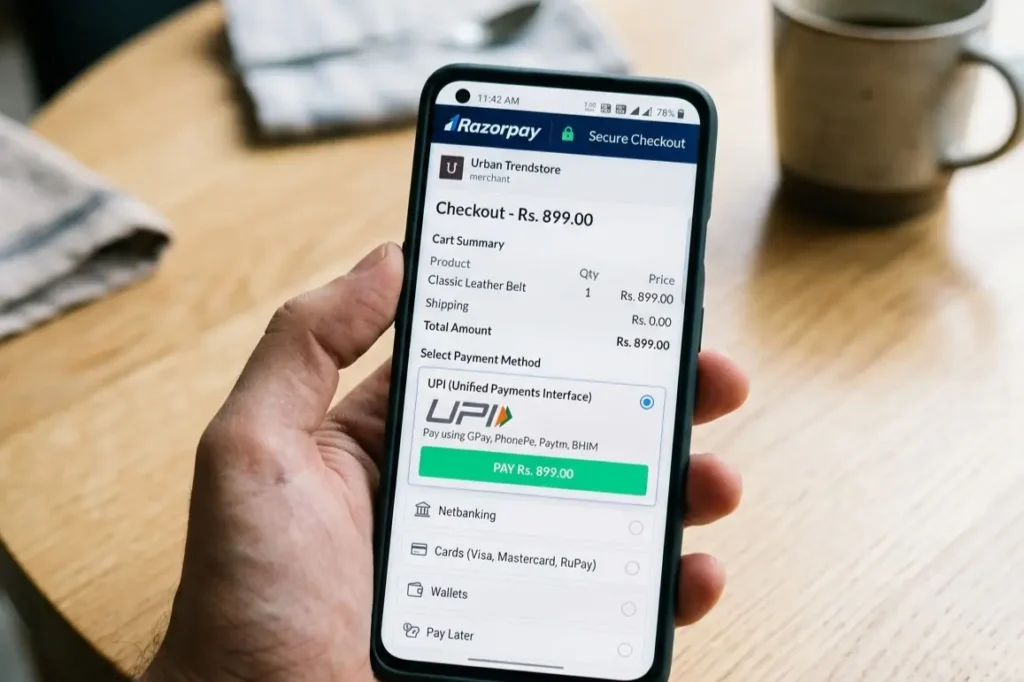
What About Custom Development?
Custom ecommerce is for when the standard platforms genuinely do not fit your business logic.
We’ve built custom stores for brands with complex pricing rules, multi-location inventory, and WhatsApp-first checkout flows that neither Shopify nor WooCommerce handles cleanly without expensive workarounds.
The honest reality of ecommerce website cost india for custom builds: you’re looking at Rs. 1,50,000 and upward with a 3 to 6 month timeline. That investment makes sense when you are doing real revenue and need infrastructure that matches your operation. It does not make sense for a first launch.
What we typically recommend to founders who ask: start on the platform that fits your current stage, build the processes that prove demand, and build custom when the standard platforms become the actual bottleneck, not before.
Before you finalise any platform, it is worth going through our D2C website features checklist to make sure the build covers everything an Indian store actually needs at launch, from UPI checkout to trust signals and GST invoicing. Most founders realise mid-build that they missed two or three things that now need workarounds.
Our UI UX design services also feed directly into every ecommerce build we do, whether Shopify, WooCommerce, or custom. The checkout experience, trust signals, and product page structure are designed before a single line of code is written.
FAQs
Is Shopify or WooCommerce better for small businesses in India?
For small businesses just launching, Shopify is faster and easier to manage without technical support. For small businesses already generating revenue who want to reduce fees, WooCommerce on good hosting typically comes out cheaper over 12 to 24 months. The right answer depends on your current stage, not a universal rule.
What are Shopify transaction fees in India compared to WooCommerce?
On Shopify’s Basic plan in India, you pay a 2% Shopify transaction fee plus your payment gateway’s fee such as 2% for Razorpay, giving a combined cost of 4% or more per order. WooCommerce only charges the gateway fee with no platform tax on top, making it more cost-efficient as revenue grows.
Does Shopify support GST invoicing in India?
Shopify supports GST invoicing through third-party paid apps. WooCommerce handles it through free or low-cost plugins with more granular control over HSN codes and multi-rate GST, which is generally the more reliable setup for GST-registered Indian businesses.
Which ecommerce platform is best for D2C brands in India?
Most early-stage D2C brands launching under Rs. 3 lakh per month benefit from Shopify’s speed. Established D2C brands doing Rs. 5 lakh or more monthly typically find WooCommerce more cost-effective once platform fees and apps are factored in. Both can work and the platform should follow your business model.
Can I migrate from Shopify to WooCommerce later?
Yes, but it is not seamless. Product data migrates well. Order history, customer accounts, and some integrations require manual work or paid migration tools. Switching platforms mid-growth also means a temporary SEO impact. Choosing the right platform at the start avoids this cost entirely.
What is the cheapest way to build an ecommerce website in India?
A WooCommerce store on shared or managed hosting can be built for Rs. 25,000 to Rs. 60,000 with minimal ongoing fees. Shopify’s starter setup costs are similar, but monthly fees of Rs. 1,994 to Rs. 5,599 plus GST and transaction fees make it more expensive over time.
Which platform is better for Tier 2 and Tier 3 city customers in India?
Both can be optimised for mobile-first, low-bandwidth performance. WooCommerce gives more control over image compression, caching, and server-side optimisation. Shopify handles hosting performance automatically. A well-configured WooCommerce store typically achieves better Core Web Vitals scores when optimised by an experienced team.
Talk to an Ecommerce Developer
We’ve helped founders across India, from skincare D2C brands in Bangalore to B2B suppliers in Surat, choose the right platform, build it right the first time, and structure the store around how Indian buyers actually behave.
We’re a Shopify Partner, Webflow Expert, and Google Partner studio. We do not have a platform preference. We have a business-outcome preference.
If you’re spending time second-guessing Shopify vs WooCommerce instead of actually selling, let’s sort it out together.
Start the conversation at resourcegeeksnetworks.com/contact
Resource Geeks Networks, Website Development, UI UX Design and Ecommerce Strategy. Indiranagar, Bangalore.