

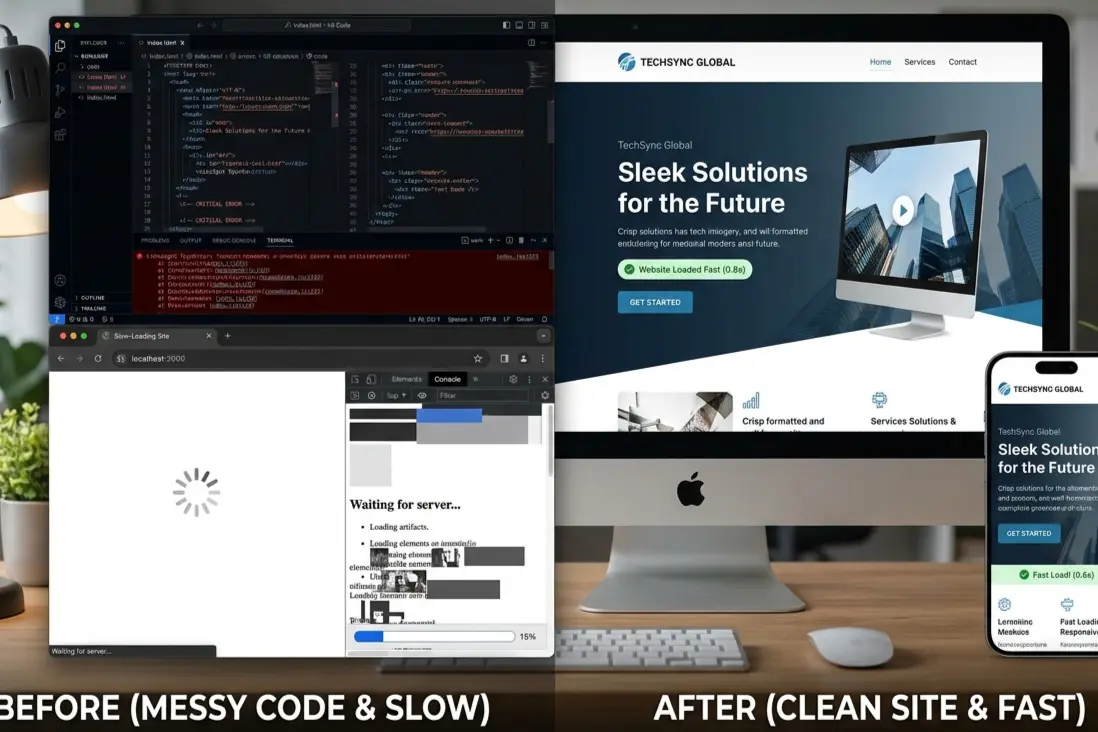
The web is getting louder. Thousands of websites go live every single day and most of them quietly fail. Not because of bad ideas, but because of bad frontend experiences. In a world where users scroll past anything that loads slowly or looks off on their phone, your frontend is either your biggest asset or your most expensive liability.
Frontend development services are not just about making a website look good. They are about making it work – fast, clean, and without friction.
At Resource Geeks Networks, we have spent years building digital products for Indian startups, growing brands, and global enterprises. And the one thing we keep seeing? The gap between a forgettable website and a high-converting one almost always comes down to how the frontend was built.
What is Frontend Development and Why Does It Matter Now?
Frontend development is everything a user sees and touches on your website – the layout, buttons, animations, forms, fonts, and loading speed. It is built using HTML CSS JavaScript development as its foundation, layered with modern tools and frameworks to make experiences feel seamless. If you want to understand how this fits into the bigger picture of building a digital product end to end, our complete website development guide breaks down exactly how all the layers come together.
But here is what most competitors miss: in 2026, frontend development is no longer just a design concern. It is a business performance concern. Google’s Core Web Vitals now directly influence how high your site ranks. AI search engines like ChatGPT and Google’s AI Overview pull structured, well-organised pages to the top of their results.
If your website’s frontend is slow, cluttered, or broken on mobile, you are losing customers before they even read your first line of copy.
The Business Cost of a Poor Frontend Experience
Here is something your website analytics might be hiding from you.
Most businesses look at bounce rate and assume it is a content problem. But often, the real issue is structural. Users do not bounce because your offer is bad. They bounce because the page took four seconds to load, the menu broke on their phone, or a button did not respond fast enough.
This is where responsive frontend development services pay for themselves. A well-built frontend:
- Reduces page load time significantly, improving both user retention and SEO rankings
- Ensures your website renders correctly across all screen sizes – from budget Android phones to large desktop monitors (critical for Indian audiences where mobile traffic dominates)
- Creates a consistent brand experience that builds trust before a single word is read
We have rebuilt frontends for clients who were running ads to a broken site and burning budget daily. Within weeks of launching a properly built responsive web design service, their conversion rates shifted – not because their offer changed, but because the experience finally matched their ambition.
What Technologies Actually Power a Great Frontend?
This is the section most blogs skip past with a generic list. We are not going to do that.
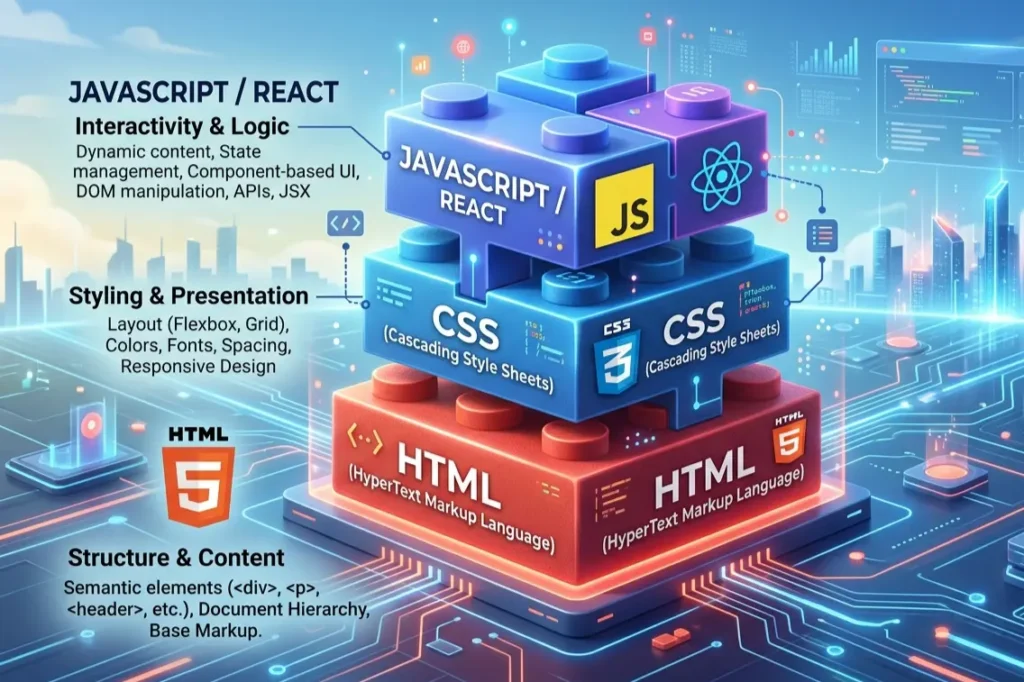
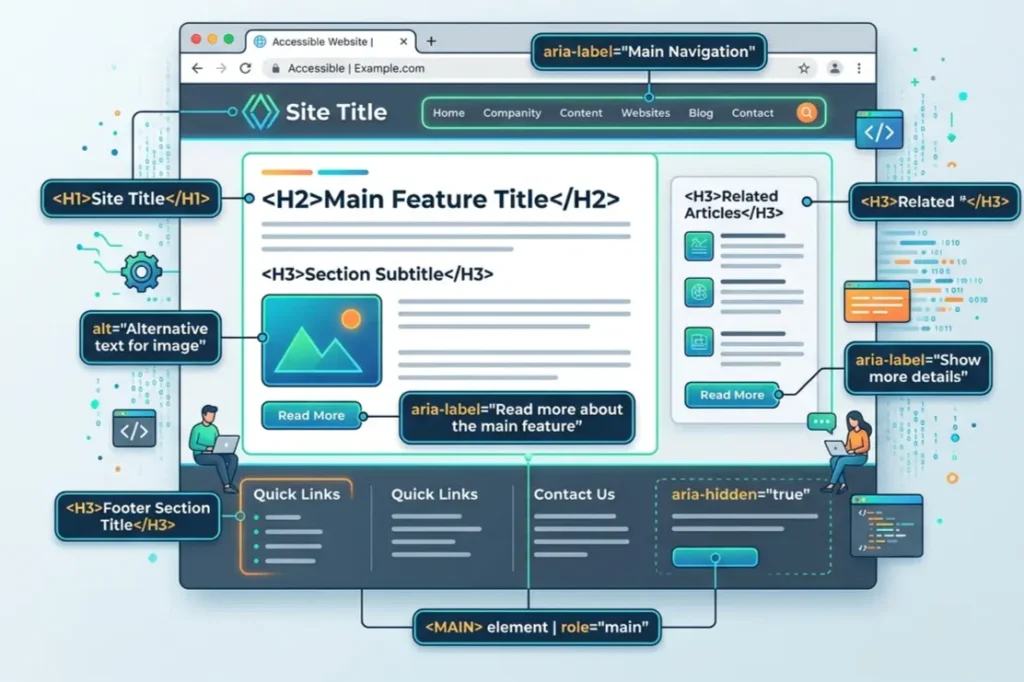
HTML is the skeleton of every web page. It has been around forever, but how it is written in 2026 – with semantic tags, ARIA roles, and structured data markup – directly determines whether AI search engines like Google’s AI Overview can understand and surface your content.
CSS is the skin. Modern CSS has become extraordinarily powerful. Grid systems, container queries, cascade layers – these reduce dependence on JavaScript for layout and make your site significantly faster. We have seen frontend code get 30-40% leaner just by leveraging what native CSS now offers.
JavaScript is the muscle. It powers interactivity, dynamic content, and real-time behaviour. But JavaScript misused is also the number one cause of slow sites. Our philosophy at Resource Geeks Networks is to ship the minimum JavaScript necessary – every kilobyte matters for users on Indian mobile networks.
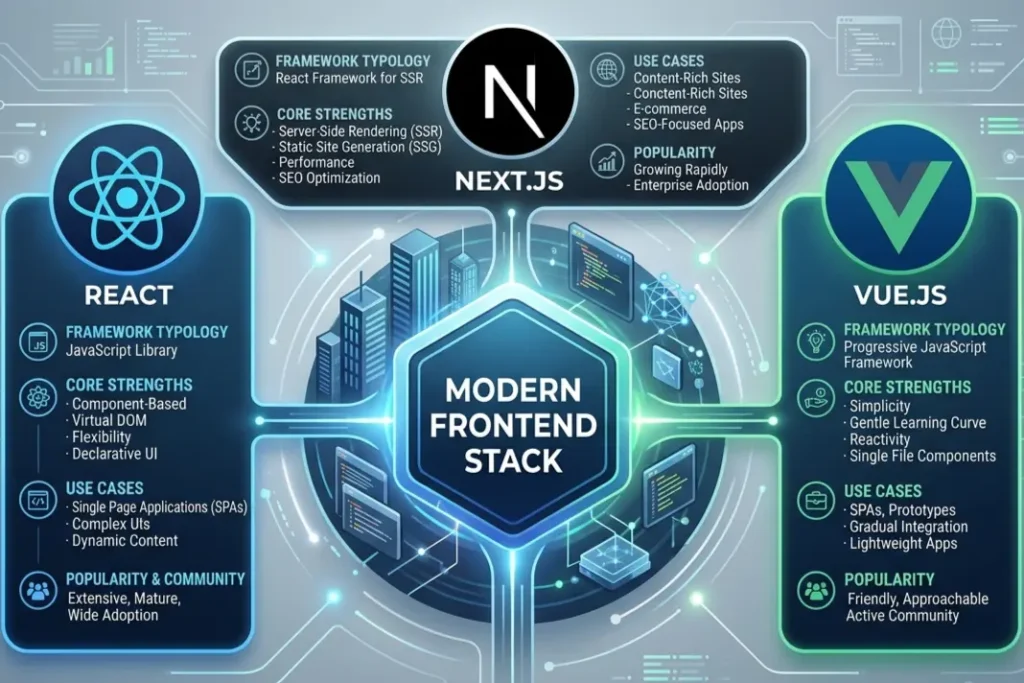
React is our primary framework of choice for component-based, scalable frontends. It enables us to build reusable interfaces that are maintainable as your business grows, without rewriting code from scratch every time you expand.
Responsive Web Design Services – Not Optional Anymore
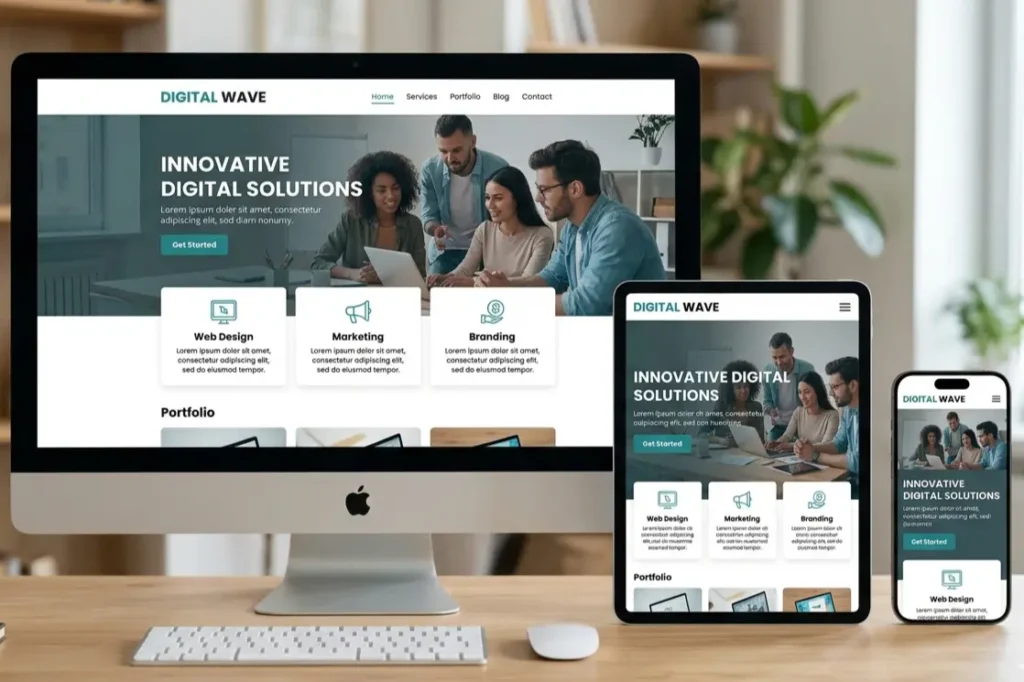
If your website does not work beautifully on mobile, you do not have a website. You have a brochure that 60% of your visitors cannot read.
India’s internet is mobile-first. A significant majority of web traffic in India flows through smartphones, many of them mid-range devices on 4G networks. A responsive web design service is not a premium add-on here. It is table stakes.
What separates genuine responsiveness from just “mobile-compatible” is intention. We design every layout to behave naturally on every screen – not just to shrink. Typography adjusts. Touch targets expand. Navigation restructures. Images load in the right format and size for the device being used. This is where frontend development and UI UX design principles work hand in hand – because a responsive layout built without a sound design system will still feel broken, even if it technically fits the screen.
And if you are wondering whether your site’s responsiveness is affecting your search rankings – it is. Google’s mobile-first indexing means the mobile version of your site is what gets ranked. A desktop-beautiful, mobile-broken website is a direct revenue leak.
Performance Optimization: The Gap Most Agencies Miss
Here is something we notice across competitor blogs: they mention performance, but they stop at “use lazy loading” and “compress images.” That is surface-level advice.
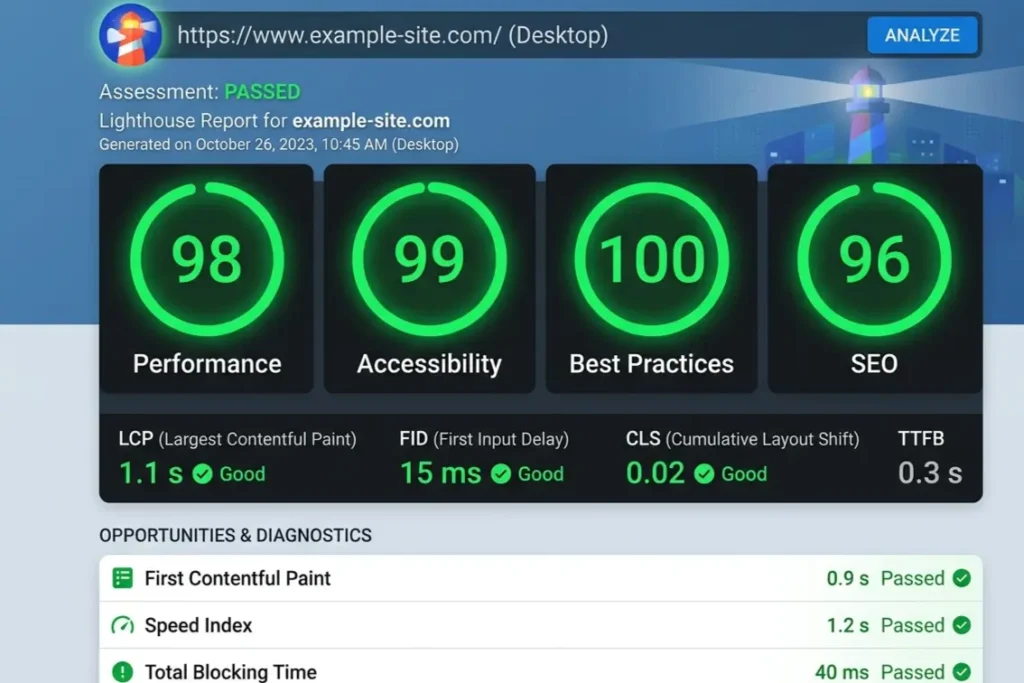
Real performance in frontend web development goes deeper. Core Web Vitals are Google’s three performance metrics – Largest Contentful Paint (how fast your main content loads), Interaction to Next Paint (how quickly your page responds to user actions), and Cumulative Layout Shift (how stable your layout is as it loads). Every one of these affects both your Google ranking and your AI search visibility. We cover this in detail through our website performance optimization services for businesses that want measurable speed improvements, not just a good Lighthouse score in a demo.
A common mistake many Indian businesses make is hiring frontend developers who can build something that looks good in demos, but has not been optimised for real-world conditions – patchy networks, older devices, simultaneous users.
At Resource Geeks Networks, every frontend we ship goes through performance testing before handoff. We test on real device conditions, not just clean localhost environments. This is a workflow discipline, not an afterthought.
Modern Frontend Frameworks for Websites in 2026
The ecosystem is moving fast, and not every trend is worth chasing. Here is an honest take.
React with Next.js remains the most production-proven combination for businesses that need performance, SEO, and scalability together. Server-side rendering through Next.js means your content is visible to search engines and AI crawlers from the first request – no waiting for JavaScript to hydrate.
What about AI-powered development? Tools like GitHub Copilot are accelerating how quickly we can scaffold interfaces. But – and this is important – AI tools generate code faster, not necessarily better. Experienced frontend developers still make the architectural decisions that determine whether your site performs at scale.
The modern frontend frameworks for websites that matter in 2026 are the ones that prioritise:
- Server rendering over pure client-side JavaScript
- TypeScript for maintainable, error-resistant codebases
- Accessibility compliance built in (the European Accessibility Act mandates this globally from 2026 – Indian businesses with international traffic are affected)
- Progressive enhancement – your core content works without JavaScript, then enhances with it
Accessibility and AI Search Readiness – The Angle Competitors Ignore
This is the content gap we consistently find missing in competitor articles about frontend development services: the intersection of accessibility and AI discoverability.
When users type “what is the best framework for frontend development” into ChatGPT or ask Google’s AI Overview, the AI pulls from pages that are semantically structured – proper heading hierarchy, ARIA labels, descriptive alt texts, clean schema markup. An accessible website and an AI-readable website are, functionally, the same thing.
This means investing in accessibility is not just an ethical decision (though it is that too). It is a competitive SEO move.
Here is the other angle nobody talks about: voice search. As voice interfaces grow, people are literally asking conversational questions to find services. “Which company offers responsive frontend development services in India?” Your website needs to be structured so that AI can extract and surface your answer directly.
We build all our frontends with this in mind – semantic HTML, structured headings, descriptive link text, and schema markup baked in from day one.
What does frontend development include? In short: everything between the server and the user’s eyes. That is HTML, CSS, JavaScript, framework integration, performance optimisation, accessibility, and responsiveness.
FAQ
1. What does frontend development include?
Frontend development covers everything users interact with on a website – the visual layout, navigation, buttons, animations, and forms. It is built using HTML CSS JavaScript development as its foundation and can use modern frameworks like React or Vue to manage complex, interactive interfaces. It also includes performance optimisation, responsive design, and accessibility implementation.
2. How much does frontend development cost in India?
Costs vary significantly depending on project scope, complexity, and the team’s experience level. A simple responsive website can cost anywhere from Rs. 30,000 to Rs. 1,50,000 and above, while complex, custom-built platforms are priced higher. At Resource Geeks Networks, we offer transparent pricing – you can review our packages at resourcegeeksnetworks.com/pricing.
3. How long does it take to build a responsive website?
For a standard business website with responsive web design services, expect 3 to 6 weeks. More complex builds with custom interactions, CMS integration, or large-scale component libraries can take 8 to 14 weeks. Timeline is largely driven by how quickly decisions and content are provided by the client.
4. What is the best framework for frontend development?
React paired with Next.js is the most widely recommended combination for businesses in 2026. It supports server-side rendering, which means your content loads faster and is readable by both search engines and AI crawlers from the first request. For simpler projects, plain HTML CSS JavaScript development may be sufficient without a framework.
5. What is the difference between frontend and backend development?
Frontend development is what users see and interact with – the visual interface, layout, and browser-side behaviour. Backend development handles everything behind the scenes – databases, servers, APIs, and logic. A complete website needs both, but the frontend is what shapes the first impression, the user experience, and ultimately the conversion.
Why Choose Resource Geeks Networks for Frontend Development?
Here is the honest version.
We are not the cheapest option. We are not a marketplace where you pick from a template. We are a design and engineering team that treats your frontend as a business system, not a visual exercise.
We have built for brands across India, the UK, and global markets. We understand what it means to deliver a site that needs to convert on a mid-range Android device in Bengaluru and render beautifully on a MacBook Pro in London.
We offer end-to-end frontend development services – from initial wireframes and component design through to coded, tested, and deployed experiences. If you need to hire frontend developers for your website, we work as an extension of your team, not a vendor you have to manage.
Our process connects frontend directly to business outcomes. Every decision – from framework choice to font loading strategy – ties back to how your users experience your brand and whether they take the action you want them to take.
Explore our full Website Development Services or see how we approach UI UX Design as a complementary discipline. You can also browse our live projects to see what this looks like in practice.
Your website is either working for you right now, or it is not. Let us find out which – and fix it if needed.