

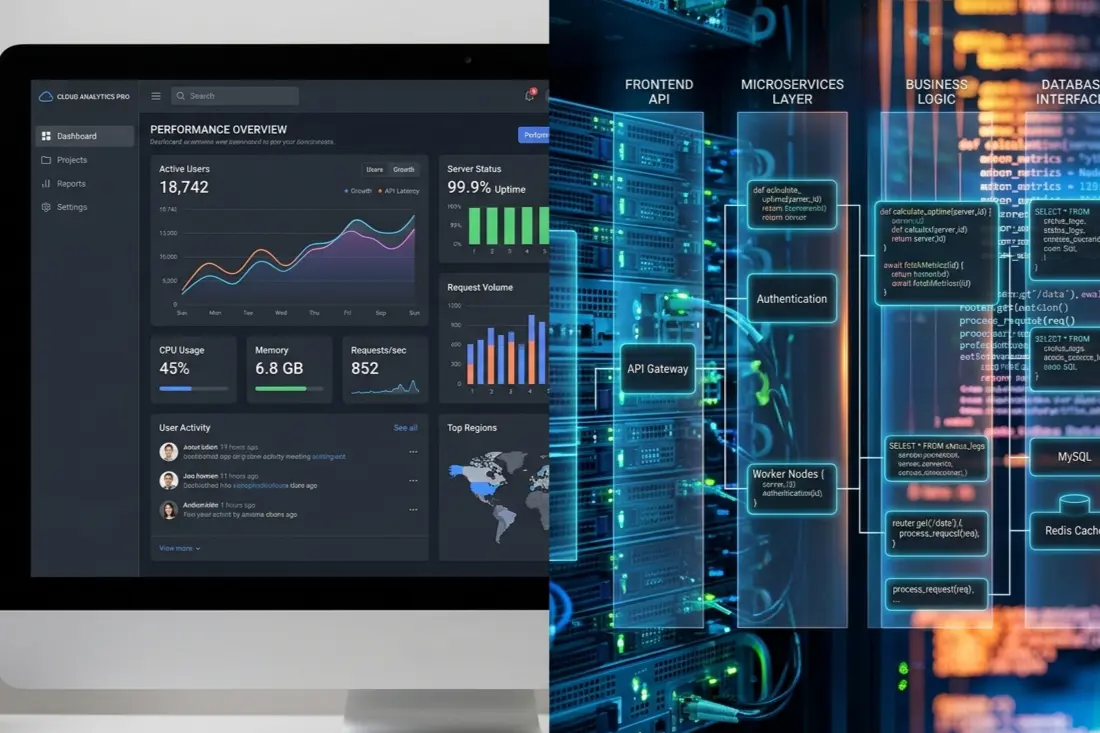
We have sat in enough post-launch calls to know how this usually goes. The website looks great. The client is happy. Three weeks later, a campaign goes live, traffic spikes, and the whole thing falls over.
Nobody planned for it. Nobody budgeted for it. And yet it happens constantly because backend development services are still treated as an afterthought in most digital projects.
That is the problem we built our practice around solving.
What the Data Actually Says About Backend Development
Before anything else, it helps to understand what the global developer community is actually experiencing right now.
The Stack Overflow Developer Survey 2025 is one of the most referenced annual studies in the software industry. This year it gathered over 49,000 responses from developers across 177 countries, covering everything from technology preferences to hiring patterns. CTOs reference it. Engineering teams use it to justify stack decisions. It is worth reading if backend choices matter to your business.
A couple of findings that directly shape how we work:
Python saw a 7 percentage point jump in adoption from 2024 to 2025, its largest single-year increase, driven by its role in AI, data science, and backend development. We have been building with Python for years. The survey confirmed what we already knew from client projects.
PostgreSQL has held the top spot as the most-used and most-desired database among professional developers since 2023. Redis grew by 8 percent as applications became more complex and the need for in-memory caching became harder to ignore.
What the survey does not capture is what happens when businesses pick technologies based on trends rather than requirements. That gap is where we spend most of our time. You can read the full breakdown at the Stack Overflow Developer Survey 2025.
What Backend Development Actually Is
Here is the version nobody tells you in the pitch deck.
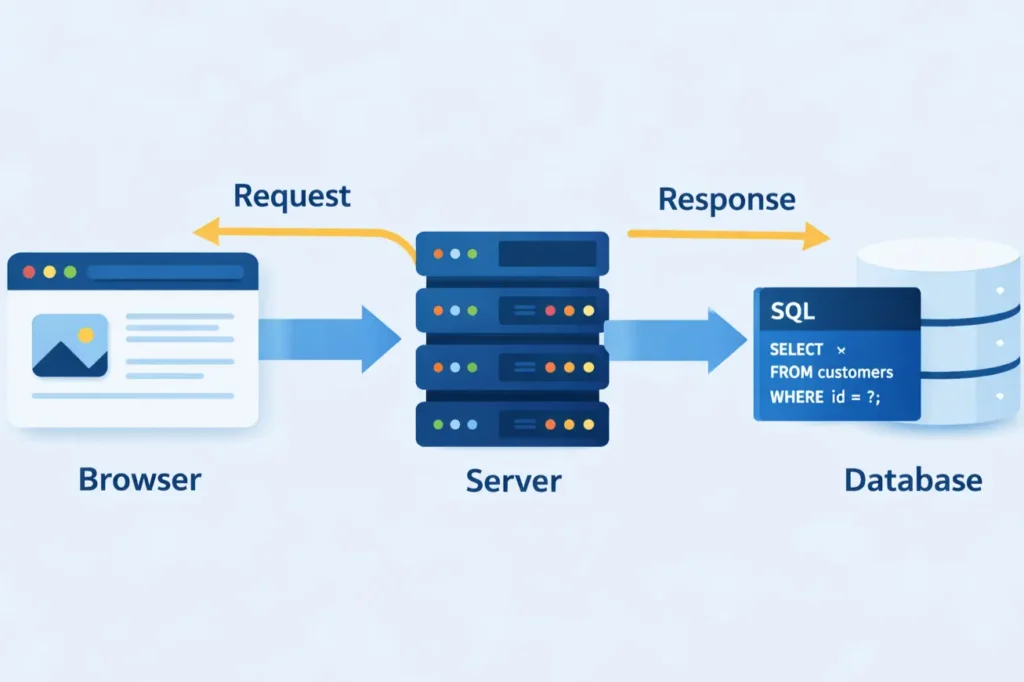
When a customer clicks “Buy Now” on your website, the frontend renders the button. That part is visible. The backend development is everything invisible that follows: checking if the item is in stock, authenticating the user, charging the card, updating the order record, triggering the confirmation email, and logging the event for your analytics.
If any one of those steps fails silently, you have a problem you might not discover until a customer calls.
Server-side development is the logic layer that keeps all of those steps working in the right sequence, at any volume, without falling over. It handles authentication, data flow, third-party connections, and business rules. The frontend makes promises. The backend has to keep them.
The difference between frontend and backend development is not just technical. It is the difference between what your product looks like and whether it actually works. We have worked with teams who spent four months perfecting their UI and four days thinking about their infrastructure. The math on that does not work in anyone’s favour.
For businesses that want both sides handled properly, our web development solutions for businesses are built to treat frontend and backend as one cohesive system from day one.
What a Broken Backend Actually Costs
Let’s be direct about this because most agencies are not.
A weak web application backend does not just slow your app down. It leaks money in ways that are hard to track and easy to underestimate. A checkout session that drops mid-payment. An inventory count that goes stale during a sale. A login system that locks out real users during peak hours.
Industry data puts average downtime costs at $5,600 per minute. For Indian ecommerce businesses running a Diwali or Big Billion Day campaign, a two-hour outage is not an inconvenience. It is a write-off.
How long does it take to build a scalable backend for a web application? Honestly, six to sixteen weeks done properly. A backend built in two weeks to hit a deadline will cost three times that to fix six months later. We have cleaned up enough of those situations to say that with confidence, and without enjoying saying it.
Scalable backend development services are not the expensive option. A rebuild is the expensive option.
The Technologies We Use and Why We Choose Them
We are not attached to any particular stack. We are attached to the outcome.
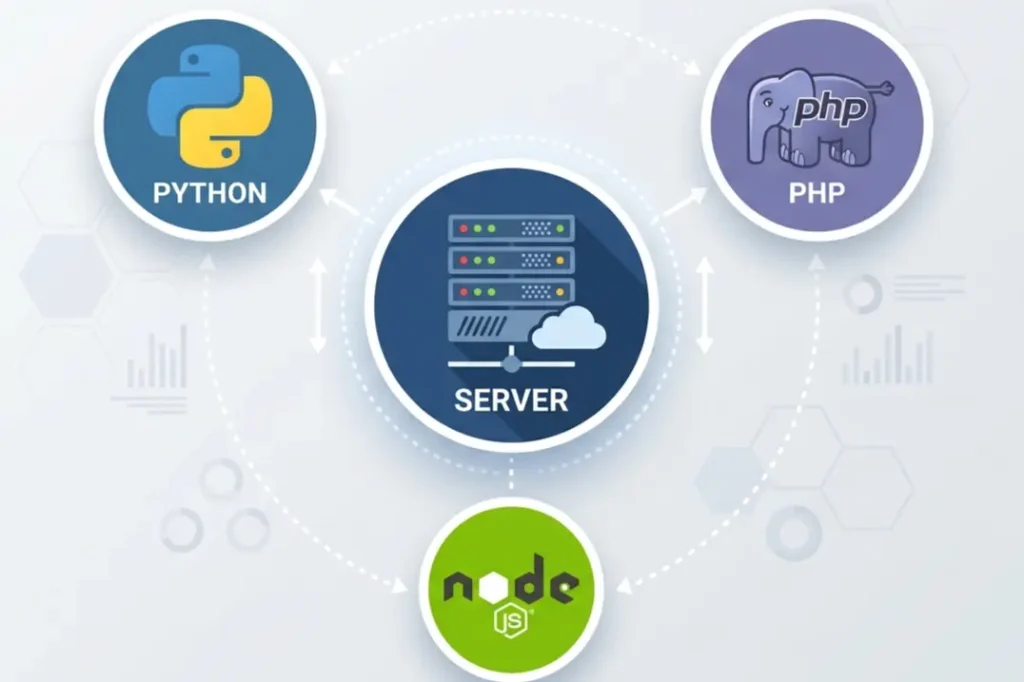
Node.js is the right call for real-time products: live dashboards, chat, notifications, anything where concurrent connections matter and latency cannot afford to climb. Python is what we reach for when a platform is data-heavy, needs machine learning integrations, or has analytical complexity baked into its core logic. The Stack Overflow data lines up with years of project experience on this front.
PHP and Laravel still earn their place on content-driven platforms, particularly for clients already running WordPress or WooCommerce who need reliability and sensible costs in their database development services without rearchitecting everything.
The honest answer to “which technology should I use” is always: it depends on what your product actually needs. Any team that tells you otherwise before asking detailed questions about your business is guessing.
When the requirement is a platform built around specific business logic rather than an off-the-shelf solution, our custom web development solutions are scoped around your actual use case, not a template.
Database Development: The Layer Nobody Talks About Until It Breaks
This is the part of server-side development that clients rarely ask about upfront and almost always wish they had.
A poorly structured database does not announce itself. It quietly slows your queries down. It makes new features harder to build. It creates inconsistencies that only appear under load. And when it finally becomes a visible problem, fixing it means touching every layer of the application built on top of it.
Good database development services mean designing schemas that anticipate growth from day one, choosing between relational options like PostgreSQL and MySQL or non-relational options like MongoDB and Redis based on how data actually flows through the system, and building indexing strategies that hold up when real traffic arrives.
We restructured the database architecture for a client whose platform was functionally sound but performatively broken. No new features. No frontend changes. Just the layer underneath, done properly. Page load times dropped by 60 percent. That number still surprises people when we mention it. It should not. The database is usually where the real performance lives or dies.
API Integration: More Than Just Connecting Things
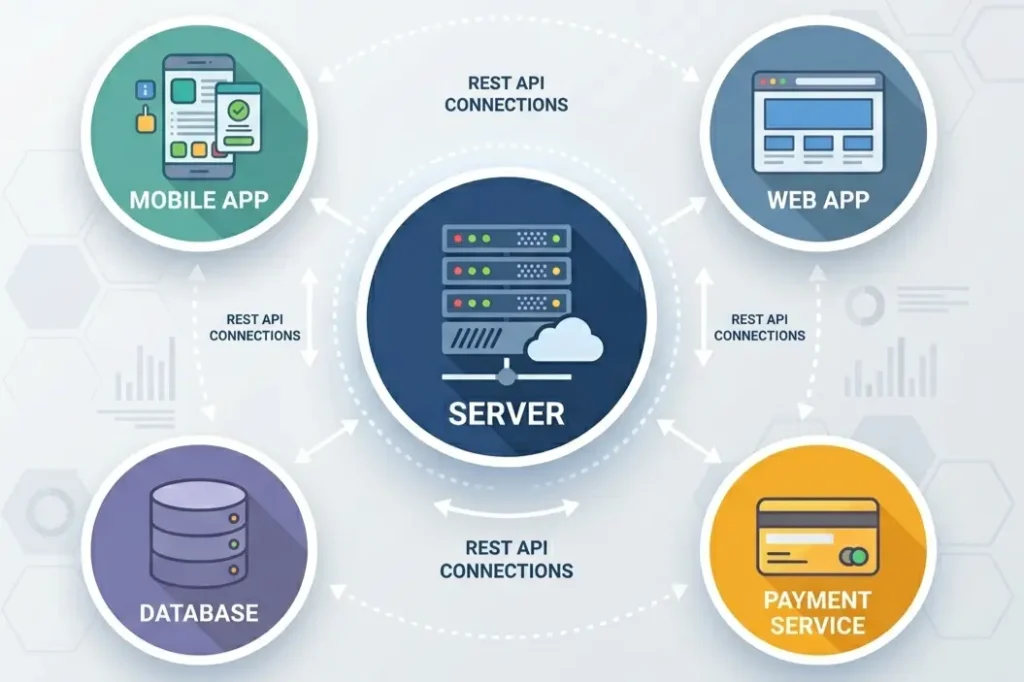
Every modern web application is a network of services talking to each other. Payment gateways, logistics partners, CRM tools, analytics platforms, authentication providers. Each of those connections is an API, and each one is a point of failure if it is handled casually.
We build REST and GraphQL APIs with authentication, rate limiting, proper error handling, and documentation written for the developer who will maintain this two years from now, not just for the sprint review. Razorpay, Stripe, Shiprocket, custom internal systems, we have integrated all of them and know where the edge cases live.
For anyone looking to hire backend developers for web applications, this is one of the first places to look. Clean API design is not glamorous work. It is the thing that saves you months of debugging eighteen months into a product’s life.
Backend for Ecommerce: Where the Stakes Are Highest
Ecommerce is the environment where every backend decision has a direct revenue consequence.
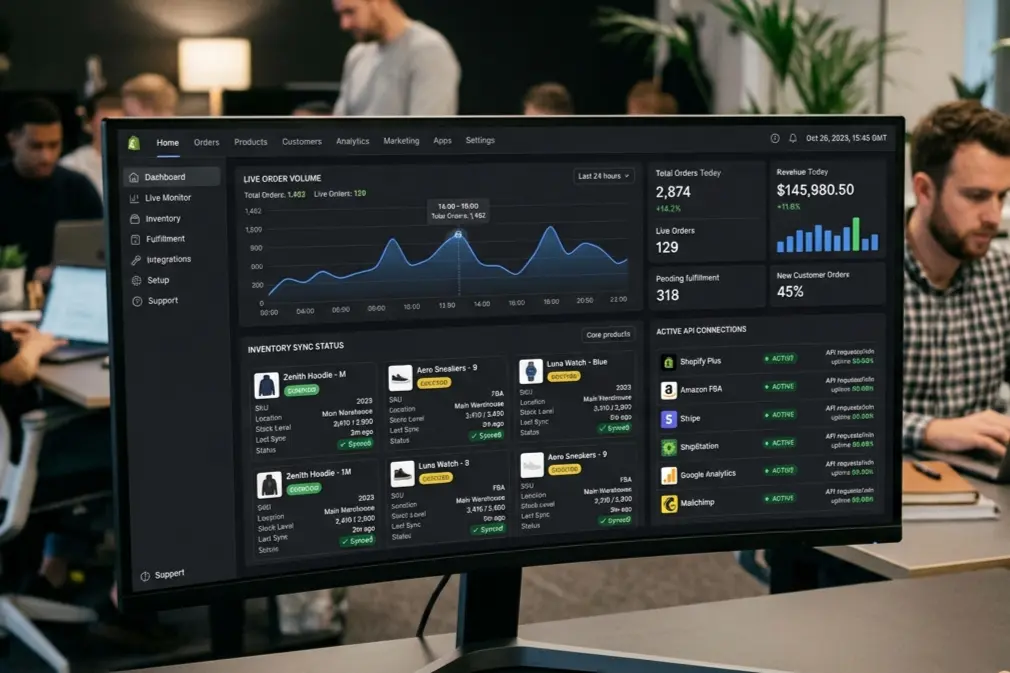
Backend development for ecommerce websites has to manage concurrent checkouts, real-time inventory, dynamic pricing logic, payment processing across multiple gateways, order state management, returns handling, and logistics API sync, all at once, all reliably, all under the kind of load that only shows up when you least want surprises.
We have built backends for ecommerce brands running across Indian and international markets. The consistent lesson is that scale cannot be retrofitted. You cannot build for 500 daily orders and then add scalability later when you hit 5,000. The architecture either supports growth from the beginning or resists it.
If you are running or launching an online store and want to understand what proper ecommerce backend development actually involves before you commit to a build, that is a conversation worth having early.
Security: A Decision Made at the Start, Not a Patch Applied at the End
We have had clients come to us after an incident. The conversations are always the same: something that should have been a default became a gap, and someone found it before they did.
Every web application backend we deliver includes encrypted data at rest and in transit, HTTPS enforcement, SQL injection prevention, input validation, role-based access control, and scheduled dependency audits. These are not premium add-ons. They are how we build by default.
For businesses in India handling user data, this is increasingly a legal question as much as a technical one. The IT Act has teeth, and data protection norms are tightening. Building a compliant backend after launch is significantly harder than building one from the start.
Rate limiting, DDoS-resilient architecture, and monitoring for anomalous behaviour are infrastructure decisions, not application features. We make them at the beginning.
Our UI/UX Design Services are designed to work alongside secure backend systems because trust is not just visual.

Frequently Asked Questions
What is backend development and why is it important?
It is the server-side logic, database layer, and API infrastructure that powers everything users do on your platform. Every click, login, transaction, and data request goes through it. If it is poorly built, it does not just slow your app down. It shapes every interaction your customers have with your business.
How much does it cost to hire backend developers for web applications?
In India, project-based backend work typically sits between Rs. 1.5 lakh and Rs. 10 lakh and above, depending on complexity and scope. Ongoing retainers are common for products in active development. The only way to get a number that means anything is to scope the project properly first.
What is the best backend technology for ecommerce websites?
Node.js handles high-concurrency well. Python suits data-driven platforms. PHP and Laravel are solid for WooCommerce and WordPress-based stores. The right answer depends on your order volume, your integration requirements, and your existing systems. Anyone who answers this question without asking about those things first is giving you a guess, not a recommendation.
Why Work With Resource Geeks Networks?
We are a Bangalore-based digital studio. We work with startups, scaling ecommerce brands, SaaS founders, and enterprise teams across India, the UK, and global markets.
We are Webflow, Shopify, and Google partners. But honestly, the thing clients mention most is not the certifications. It is that we asked the right questions before we wrote a single line of code.
Backend development services done well are invisible. Your users never think about the server. Transactions complete. Pages load. The app holds up during the campaign. That invisibility is the goal, and it requires a team that takes the backend as seriously as everything built on top of it.
If you are trying to hire backend developers for web applications who think like product partners rather than ticket-closers, we should talk.
Start a project with Resource Geeks Networks today.
Browse our full service range at the Services Overview.
Resource Geeks Networks builds strategy-led software, websites, and digital systems for businesses serious about growth.