

Every year we sit across from fresh graduates asking us the same question. How do I actually get into this field?
Not the version careers pages give them. The real version. What skills matter, what salary they can realistically expect, and why a portfolio full of beautiful screens is not enough to get past the first interview round.
We are the team at Resource Geeks Networks. We are a design and product studio based in Bangalore and we have been hiring designers, working with them on live client projects, and watching the gap between what beginners think the industry wants and what it actually does. This guide is what we tell people before they waste six months going in the wrong direction.
Start with the complete UI UX design overview to build your foundation
Is a UI UX Designer Career Actually Worth It in India?
Honestly, yes. But not for the reason most courses will tell you.
It is not just that demand is high. It is that genuinely good designers are rare. India crossed 850 million digital users in 2024. Every product those people use needs someone thinking about how it works and why it works that way. That is not a trend. That is infrastructure-level demand.
According to AND Academy’s 2026 career research, the average yearly UX designer salary in India sits around Rs. 8,00,000, well above the national average. But that number belongs to a specific type of designer. The one who can look at a broken user flow and diagnose what is actually wrong. Not the one who makes it look nicer.
The market has too many of the second type already.
What Designers Do All Day, and What Nobody Tells You
Most people picture a designer sitting at a clean desk making polished app screens. That happens occasionally. More often a typical day looks like this.
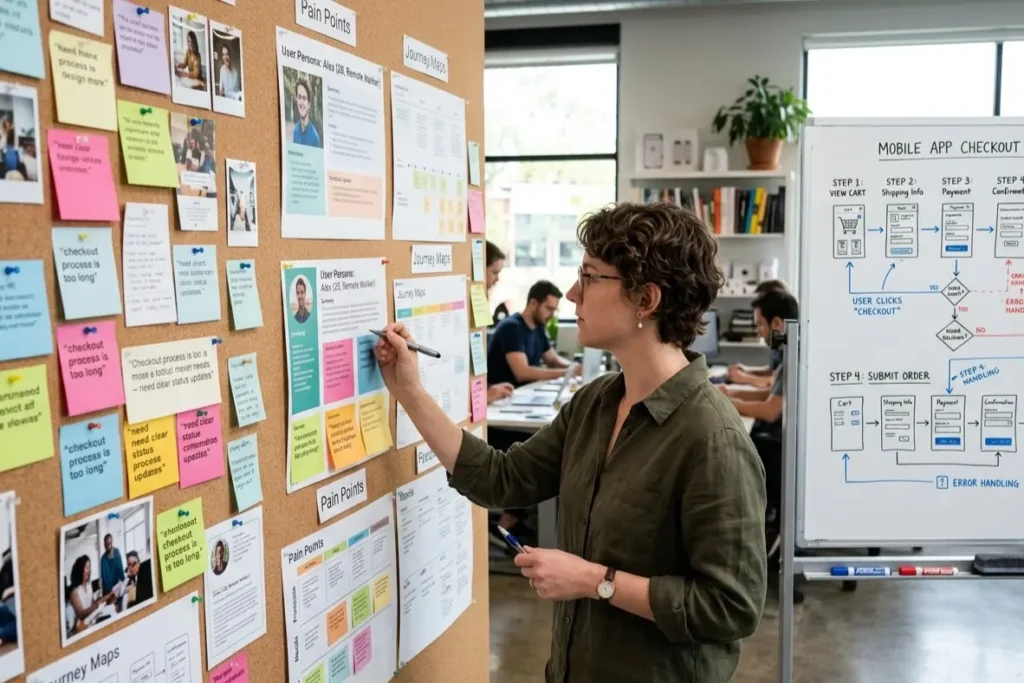
Running user research calls to understand what real people are struggling with. Mapping out where users are dropping off and trying to figure out the actual reason. Building wireframes before a client presentation. Sitting with a developer explaining why a button needs more space around it. Presenting a design decision to a founder who keeps saying it just needs to feel more premium.
We worked with a B2B SaaS client in Bangalore whose onboarding screen had a 68% abandonment rate. He was convinced it was a payment gateway bug. It was not. We sat with their users and watched what happened. People were hitting five separate decision points in the first 30 seconds of signing up. We reduced that to two. Completion rate reached 81% in three weeks without a single line of new code.
That is the job. Finding where things are breaking and understanding why before touching anything visual.
How to Become a UI UX Designer With No Experience
This is the question we get more than any other and the real answer surprises most people.
Your background genuinely does not matter that much. We have worked with designers who came from engineering, from marketing, from teaching, from customer support. What they had in common was not a degree or a specific certificate. It was a portfolio that showed how they think.
You do not need a design degree. You do not need a Rs. 80,000 bootcamp. You need three to five case studies that document a real problem, how you investigated it, what you tried, what failed, and what the final outcome looked like with a clear reason for every decision you made.
Pick an app you use every day. Find one part of it that genuinely frustrates you. Look up whether other users feel the same way. Redesign two or three screens and write down exactly why you made each choice. That is a portfolio piece. It is not a fake one. It is a real demonstration of how you approach a problem.
Master the principles that every design interviewer will test you on
The Skills That Actually Get You Hired
Here is the order most beginner guides get completely backwards.
User empathy and research thinking come first. Can you understand what someone who is not like you actually needs from a product? Can you design for a 55-year-old first-time smartphone user or a warehouse supervisor using an app with gloves on? This is not a creative skill. It is a thinking skill and it is the foundation everything else sits on.
Visual communication comes second. Typography, spacing, colour, layout, hierarchy. These are learnable but they require practice on real projects not on copying existing designs from Dribbble.
Tool proficiency comes third. Figma is used by over 80% of product teams globally in 2026. It is free, browser-based and it is where the industry lives right now. Learn it well before touching anything else.
The skill that separates hired candidates from rejected ones at the interview stage is something most guides treat as optional. The ability to explain a design decision clearly to someone who has no design vocabulary at all. We have turned down technically strong candidates because they could not walk us through their thinking in plain language. That skill is worth practising from week one.
The UI UX Career Roadmap, Stage by Stage
This is the roadmap we would hand someone starting at Resource Geeks Networks with zero prior experience. These are real timelines not aspirational ones.
Stage 1, Foundation (months 0 to 2). Learn UX fundamentals before you open Figma once. Study cognitive load, Hick’s Law, Miller’s Rule. Spend time using apps as a researcher, not a consumer. Ask why every screen is structured the way it is. The goal at this stage is not to produce anything. It is to rewire how you look at interfaces.
Stage 2, Tool fluency (months 2 to 4). Now open Figma. Rebuild existing screens from scratch not to copy them but to understand why spacing and layout decisions were made. Learn frames, auto-layout, components and basic prototyping. Most people hit core competency in six to eight weeks of focused daily practice.
Stage 3, Portfolio building (months 4 to 6). This is where most beginners stall because they confuse beautiful screens with strong case studies. Build three to five projects that show your full thinking, from the messy early research phase through iterations to the final design and every reason things changed along the way.

Stage 4, Job preparation (months 6 to 9). Practise talking through your work out loud until it feels natural. Apply consistently. Reach out directly to design leads at companies you genuinely want to work for before there is ever a job listing. Take internship work even if the pay is low because the gap between candidates with real client experience and those without it is the biggest filter in any hiring round.
Stage 5, Growth (year one onwards). Specialise deliberately. UX research, design systems, product design and motion design each have their own demand curve and their own salary ceiling. Senior specialised designers in India can charge Rs. 3,000 to Rs. 8,000 per hour for consulting work.
Your career will not launch without a great portfolio
UI UX Designer Salary in India for Freshers 2026
Real numbers, not ranges pulled from a press release.
According to PayScale’s 2026 salary data based on 181 verified salary profiles from Indian designers, here is what the field actually pays at each level.
Fresher at a design agency, 0 to 1 year: Rs. 3 LPA to Rs. 4.5 LPA Fresher at a product startup, 0 to 1 year: Rs. 4.5 LPA to Rs. 6 LPA Mid-level designer, 2 to 5 years: Rs. 8 LPA to Rs. 18 LPA Senior designer, 5 plus years: Rs. 20 LPA to Rs. 40 LPA and above Senior UX consultant freelancing: Rs. 3,000 to Rs. 8,000 per hour
Three things move your starting salary more than anything else. The quality of your case studies. Whether you have any real project experience at all, even unpaid or self-initiated. And which city you are in. Bangalore, Hyderabad, Pune and Mumbai consistently pay more than tier-two cities for the same role.
How Agencies Really Hire, the Part No One Covers
Almost every career guide covers job boards and LinkedIn Easy Apply. None of them talk about what actually fills junior roles at most design studios.
A significant number of positions at agencies like Resource Geeks Networks are filled before they are ever posted publicly. We look at portfolios that come through referrals and cold LinkedIn messages first. If someone’s case studies show genuine thinking, we will have a conversation even when there is no open role. Sometimes we create one. Most candidates have no idea this is how it works and spend months applying to listings while the actual opportunities move through a completely different channel.
What this means practically is straightforward. Pick three or four studios whose work you genuinely respect. Send a short message to the design lead. Reference something specific about a project they have done. Explain briefly what you would bring. Do not attach a CV immediately. Make it a conversation. It feels uncomfortable the first few times. It works better than any job board.
Freelance, Agency or In-House
For most beginners the answer is agency, without much debate.
Working at a design agency exposes you to multiple industries, product types and stakeholder situations in your first year. The learning that takes five years in-house compresses into two at a busy studio. It is demanding and that pressure is what you need when you are still building your instincts.
Freelancing sounds appealing early on and tends to go badly for the same reason every time. You spend nearly half your working hours finding clients, writing proposals and chasing invoices instead of designing. Come back to it after two or three years when your portfolio is strong, your rates are defensible and your network actually sends you work without you hunting for it.
In-house roles at product companies give you depth that agencies cannot. You own one product over years and that builds a kind of product intuition that is hard to develop any other way. The right time for this path is after you know which vertical genuinely interests you.
Mistakes That Quietly Kill Beginner Careers
Treating tools as the skill. Knowing Figma is not a skill any more than knowing Microsoft Word is a skill. Knowing why a design decision was made and being able to test and defend that decision is the skill. The distinction matters in every interview.
Building a portfolio of redesigns with no research behind them. Redesigning an existing app is reasonable practice. But if the case study says you thought the original looked outdated and nothing else, it will not survive an interview. Hiring managers are reading for reasoning, not aesthetics.
Waiting until the work is good enough to share. It never reaches that point because feedback is what makes it good. Share work early, share it with other designers, and get used to specific criticism. The designers who improve fastest are the ones who are most willing to have their work taken apart in front of them.
Ignoring communication as a professional skill. The ability to explain a design choice plainly to a developer, a product manager or a founder is not a personality trait. It is a learnable skill and half the role depends on it.

FAQs About UI UX Designer Career
How to become a UI UX designer with no experience?
Start with UX fundamentals before touching any tool. Understand user psychology, study apps you actually use, and build three to five case studies that show your thinking from research through to final design. Even self-initiated projects work. Apply for internships before you feel ready. The fastest growth happens inside a real team with real feedback, not alone with tutorials.
What is the UI UX designer salary in India for freshers 2026?
Based on PayScale’s 2026 data from 181 real salary profiles, freshers at agencies typically start between Rs. 3 LPA and Rs. 4.5 LPA. Freshers at product startups with strong portfolios can reach Rs. 5 LPA to Rs. 6 LPA. Bangalore and Hyderabad pay more on average than tier-two cities. Your case study quality has more influence over your starting salary than the name of any course you completed.
Is UI UX design a good career in India?
Yes. India’s digital economy is still expanding across fintech, healthtech, edtech and D2C and every product in those sectors needs design that works for real users. The designers treat it well as a problem-solving discipline first. The gap between them and designers who only know visual tools is significant, and that gap is where the real career opportunity sits.
How long does it take to learn UI UX design?
Tool basics take six to eight weeks of focused practice for most people. Building a portfolio strong enough for junior roles takes six to nine months of consistent work. The honest variable is whether you are building real case studies with documented thinking or just making screens. The first path takes longer and gets you hired. The second is faster and does not.
What skills are needed to become a UI UX designer?
In order of actual importance: user empathy and research thinking, visual communication fundamentals, Figma proficiency, and the ability to explain design decisions clearly to people without a design background. The last skill is the most underinvested one and the most visible in interviews.
Ready to build something that actually works for your users?
Most businesses investing in design are not getting what they think they are paying for. A website that looks modern but loses users at every critical step. A product that demo-ed beautifully but confuses real customers the moment they sign up.
At Resource Geeks Networks we have been building digital products and design systems for startups, D2C brands and enterprise clients across India long enough to know the difference between design that photographs well and design that actually works. If you want the second kind, we should talk.
Visit us at Resource Geeks Networks and let us start building something worth using.