By the team at Resource Geeks Networks, designers who’ve built products for Indian businesses since before ‘UX’ became a buzzword.
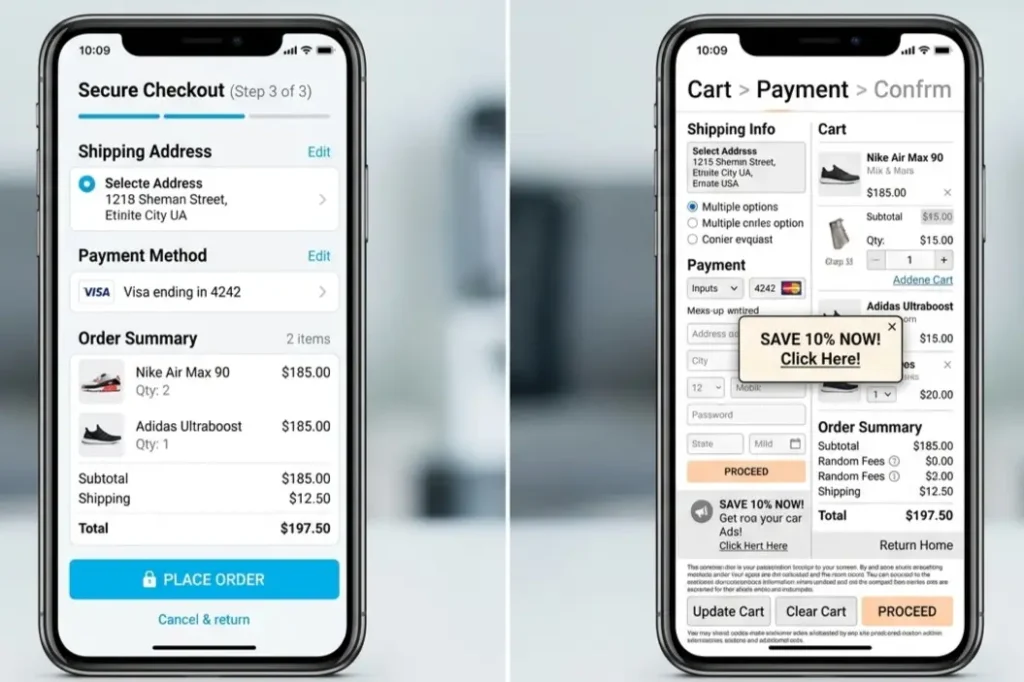
I want to tell you about a founder we worked with last year. She ran a D2C skincare brand out of Bengaluru, solid product, genuine reviews, decent ad spend. But her app had a 74% drop-off at the checkout screen. She assumed it was a payment gateway issue. It wasn’t. It was a single confusing button that said ‘Proceed’ instead of ‘Place Order.’ One word. Weeks of lost revenue.
That is UI UX design in the real world. Not mood boards. Not design awards. Revenue leaking through cracks most business owners never think to look at.
What UI and UX Actually Mean
People treat UI and UX like they’re interchangeable. They’re not.
UI, or User Interface, is everything your user sees and touches. Button colours, font size, whether your CTA stands out or drowns in the page.
UX, or User Experience, is the logic underneath. Does the flow make sense? Can someone complete a task without reading instructions?
Here’s the analogy I use with every new client: imagine a restaurant with beautiful interiors and Instagram-worthy plating. But the menu is impossible to read, the waiter can’t hear you over the music, and the bill takes 25 minutes to arrive. Gorgeous UI, broken UX. You’ll go once. You won’t come back.
Great UI UX design solves both together. One without the other is a half-solution, and users feel it immediately even if they can’t name it.
The Numbers Every Business Owner Should Sit With
I am selective about statistics. But a few in this space are hard to dismiss.
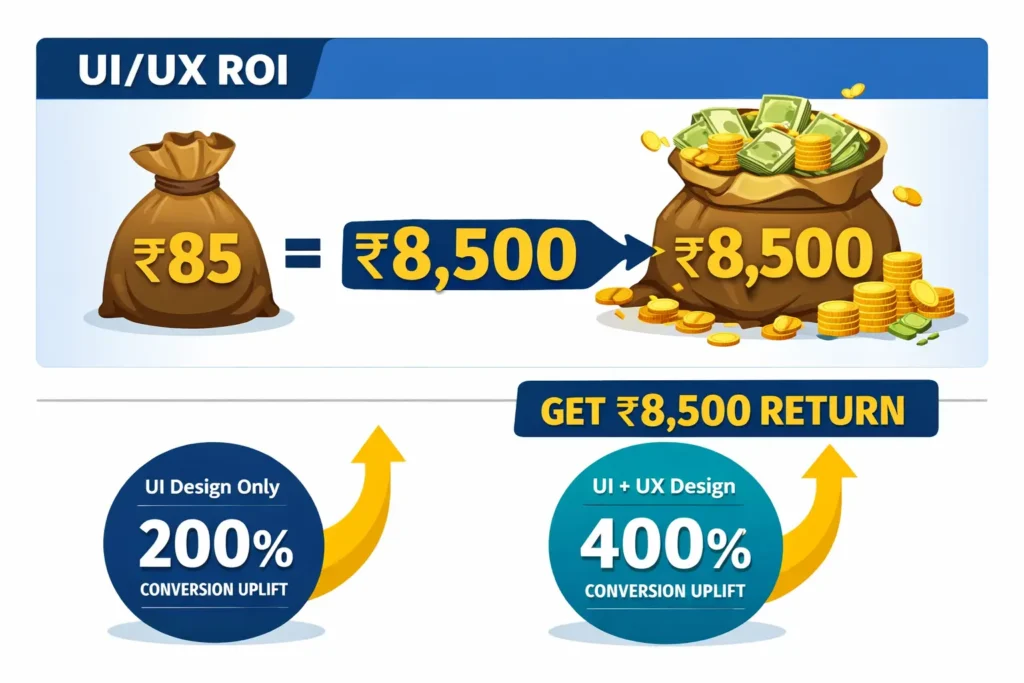
Research from Maze puts UX ROI at 9,900%. Every Rs. 85 invested in UX returns approximately Rs. 8,500. A well-designed UI can lift conversions by 200%. Add strong UX strategy and that number reaches 400%.
Here is the one that should stop you: 88% of users will not return to a website after a bad experience. Not might not. Will not. And that decision happens in under 50 milliseconds, before they have read a single word you have written.
India’s UX design market was projected to reach Rs. 2,244 Crore by 2025, one of the fastest-growing in Asia-Pacific. The global market is expanding at 32.05% CAGR through 2031.
Design is not decoration. It is infrastructure.
How the Process Actually Works
The biggest reason businesses delay investing in design is that the process feels like a black box. Designers disappear for weeks and return with something nobody asked for. When that happens, the problem is never design itself. It is a lack of structure.
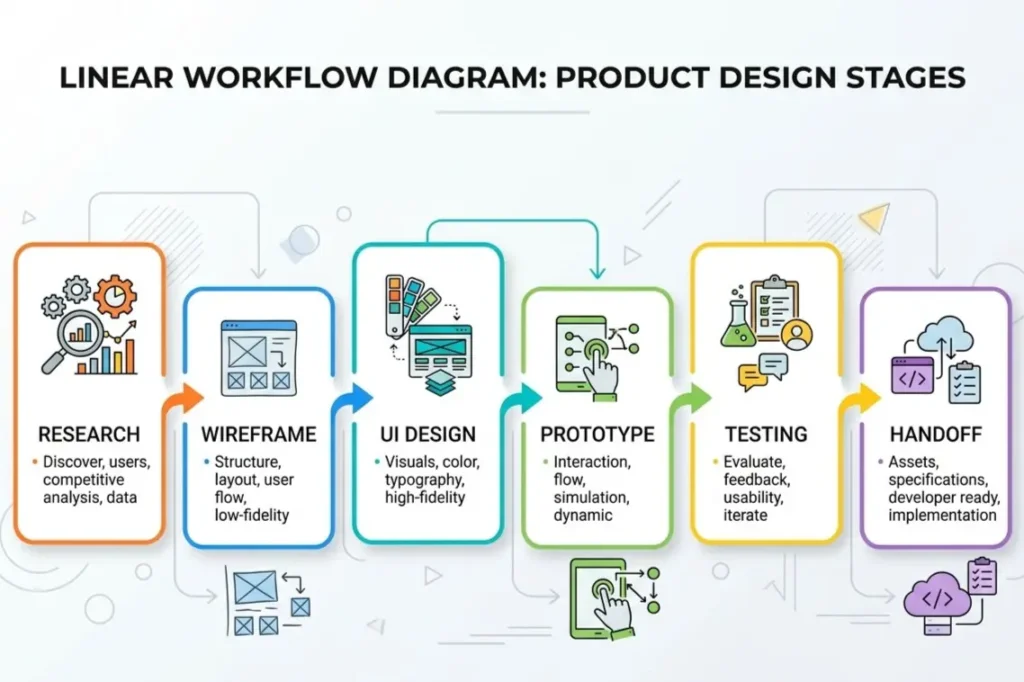
Here is what a real process looks like.
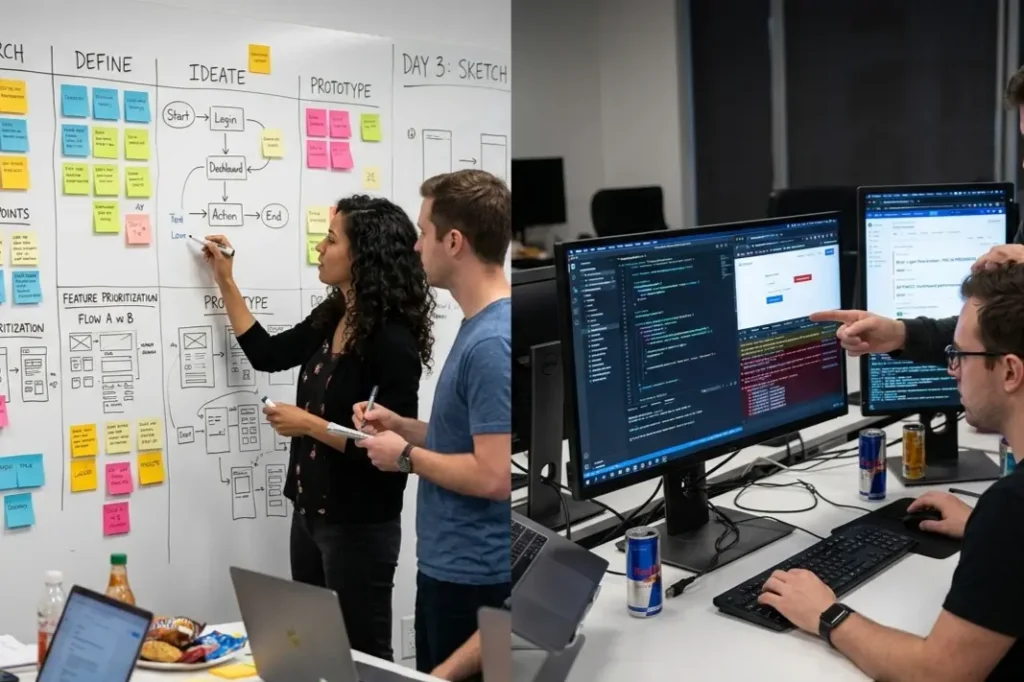
Research and Discovery. No assumptions. We talk to your users, review your analytics, and study your competitors before a single screen is sketched.
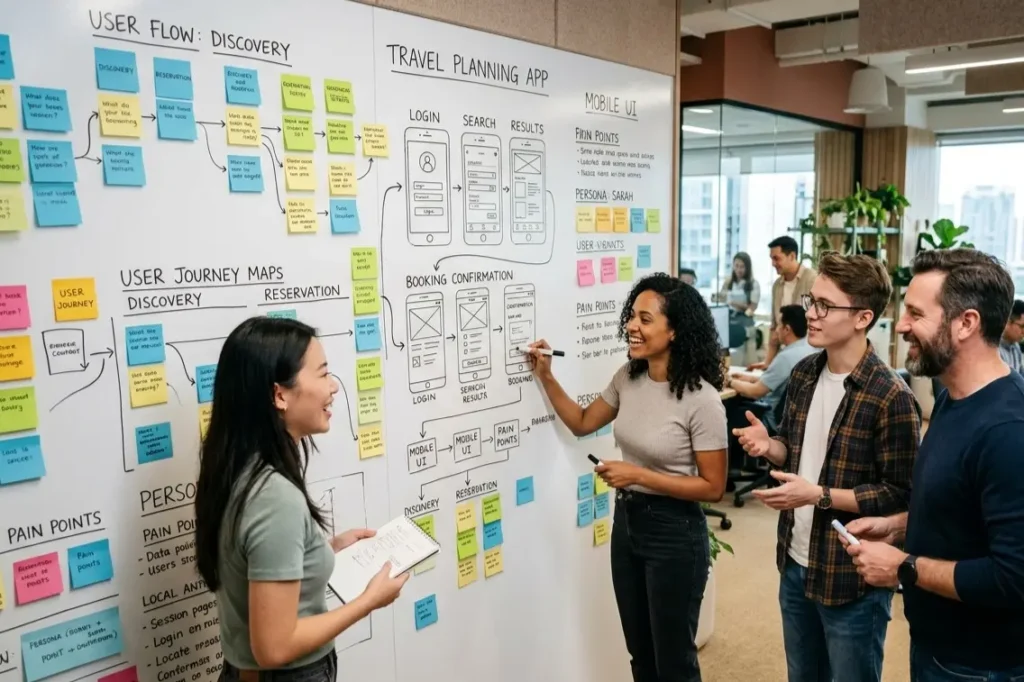
Wireframing. Structure before style. Think of it as a floor plan. If the layout does not make sense, no visual polish will save it.
UI Design. Colour, typography, and components come in now, built to guide the eye and reflect your brand without overpowering the user.
Prototyping. Interactive mockups let you experience the product before development starts. Expensive problems get caught here cheaply.
User Testing. Real users, unscripted. The feedback is almost always humbling. It is also the most valuable thing in the process.
Development Handoff. Precise specifications so developers build exactly what was designed. No guesswork, no drift.
Most projects at Resource Geeks Networks run this cycle in 4 to 8 weeks. Some businesses only need one stage, a usability audit, a UI refresh, or a prototype for investor validation. Explore our step-by-step UI UX design process guide →
The Principles That Actually Matter
After years across fintech, healthcare, edtech, and D2C, the same principles keep separating the products users love from the ones they quietly abandon.
Simplicity over cleverness. Make the user feel smart, not the designer.
Consistency builds trust. Predictable buttons, spacing, and interactions create a sense of reliability. Break the pattern without reason and users feel uneasy, even if they cannot explain why.
Accessibility is not optional. Designing for cognitive and physical diversity improves the experience for everyone. It is also increasingly a legal expectation, not a feature.
Visual hierarchy drives action. If your primary CTA blends into the page, that is a conversion problem, not a styling preference.
Feedback prevents exits. When a user taps a button, something should visibly happen. Silence creates doubt. Doubt creates drop-off.
Applying all five consistently across every screen of a real product is where the real work lives. Master the core principles of great UI UX design →
The Tools Shaping the Industry in 2026
The tool matters far less than the designer using it. But here is what the industry is actually running on.
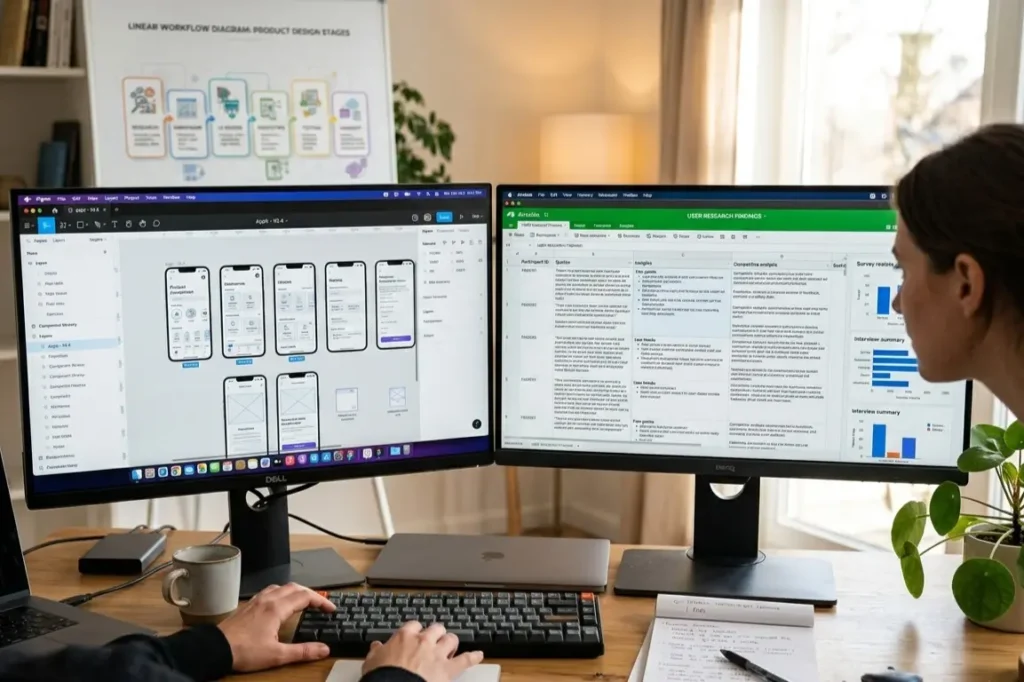
Figma dominates for collaboration and prototyping, especially across distributed teams. Adobe XD holds ground for complex interaction design. Sketch remains popular among macOS-first teams. Maze has become essential for rapid user testing without a lab.
AI has changed the pace significantly. In a survey of 100 UX designers, 93% are already using generative AI tools in their workflow. 73% say AI as a design collaborator will have the most impact in 2026. Figma AI can now generate entire design systems from a product brief. Designers are doing less mechanical production and more of the thinking that actually requires human judgment.
See the top UI UX design tools designers swear by →
Why Startups Cannot Afford to Wait on Design
The conversation I dread most: a founder, 18 months in, product rebuilt twice by developers, asking why users still do not get it. Almost always, design was pushed to ‘later.’
Redesigning a product with an existing user base costs exponentially more than designing it right the first time. You are paying for rework, user re-education, and months of compounding poor metrics.
In 2025, 85% of companies increased digital experience spending. 91% planned to expand it in 2026. A focused 4 to 6 week design sprint before development begins can establish your design system, validate your core flow, and eliminate months of rework.
The question is never whether you can afford good design. It is whether you can afford what bad design quietly costs you every month.
How to Choose a UI UX Design Company in India
Anyone can screenshot beautiful work. Here is what to actually evaluate.
Ask for case studies with outcome data, not just visuals. Did bounce rate drop? Did conversion improve? Did support volumes fall because navigation became clearer?
Ask how they handle pushback. If an agency takes your brief and disappears without asking hard questions, that is a red flag. Good design partners challenge assumptions early.
Ask how much time they spend on research before designing. The best teams spend 30 to 40% of project time understanding users before opening any tool. Agencies that jump straight to visuals are guessing.
At Resource Geeks Networks, every engagement starts with discovery. Understanding your users, your market, and your goals before a single pixel is placed. That is not process for the sake of it. It is what determines whether the final product actually works.
Quick Answers to Questions We Hear Every Week
Does UX design help SEO?
Yes. Google’s Core Web Vitals measure load speed, visual stability, and interactivity. Bounce rate and session duration are behavioural signals. A confusing site drives users away fast and search engines track that.
How do I know if I need a redesign?
Bounce rate above 55%, unexplained checkout abandonment, navigation complaints in user feedback, or conversion that has plateaued despite healthy traffic. Tools like Hotjar and Microsoft Clarity show you exactly where users leave.
What does it cost in India?
A focused flow or landing page runs Rs. 25,000 to Rs. 75,000. A full product design cycle with research, prototyping, and testing ranges from Rs. 1,00,000 to Rs. 5,00,000 and above. The better question is what a broken checkout is costing you per month right now.
Is UI UX a good career in India? The market is strong, especially at mid and senior levels. Freshers earn Rs. 5 to 8 LPA, mid-level designers Rs. 11 to 15 LPA, and senior professionals Rs. 20 LPA and above. The differentiator at every level is a portfolio that shows thinking, not just taste. Thinking of a career in UI UX design? Read this first → and when you are ready to put your work together, Learn how to build a UI UX design portfolio that gets hired →
One Last Thing
Businesses that take design seriously from day one share a pattern. They spend less time apologising to customers. Support volumes are lower. Retention is higher. CAC drops because word of mouth does what paid ads cannot.
Design is not a line item to negotiate down. It is the thing your users interact with every single day.
If your product is leaking users and you are not sure why, let’s talk. A conversation costs nothing. The leak costs more every day it goes unfixed.